Showing posts with label Jill McDowell. Show all posts

Wednesday, June 8, 2022

StencilGirl® Art Journaling

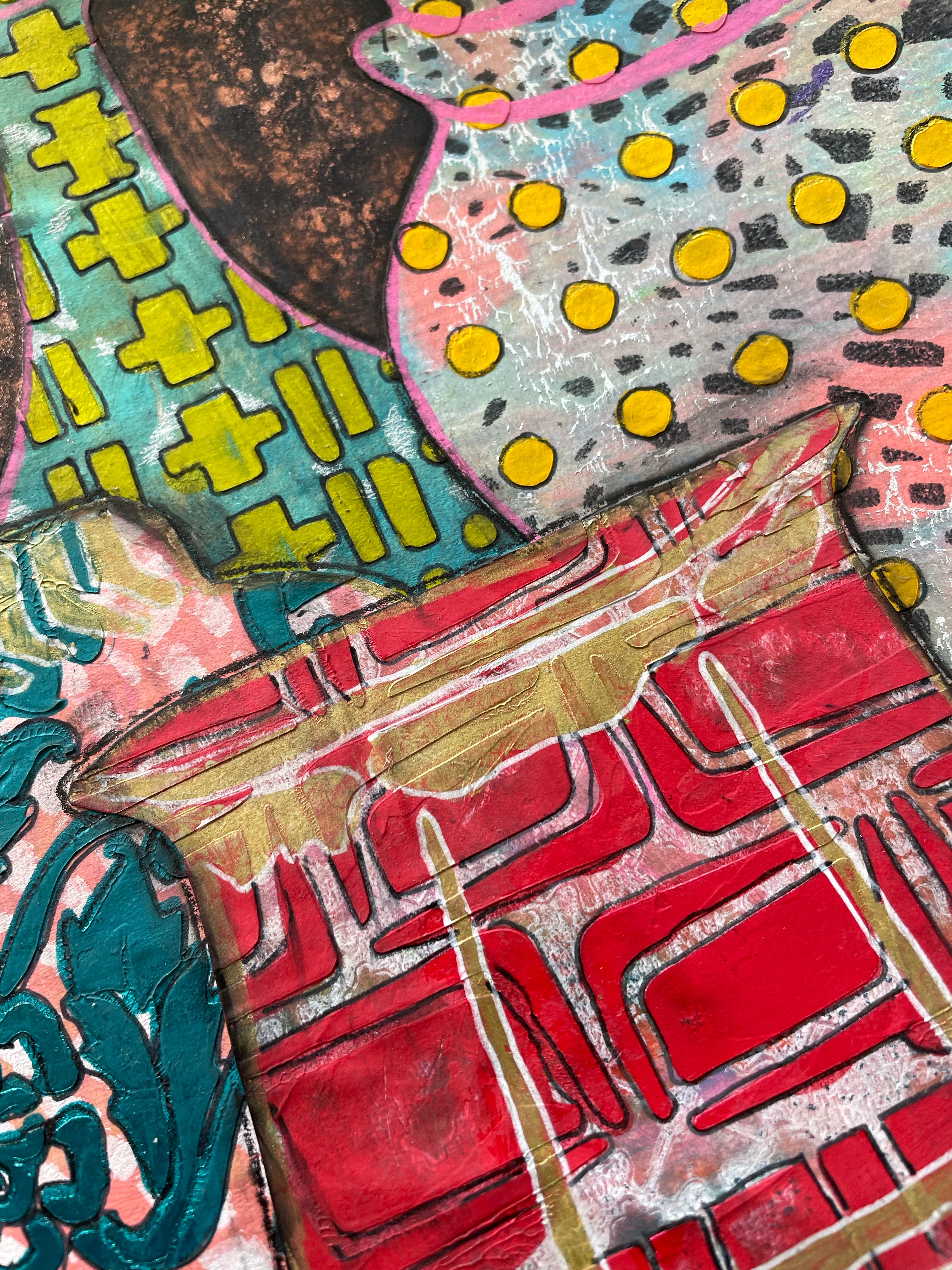
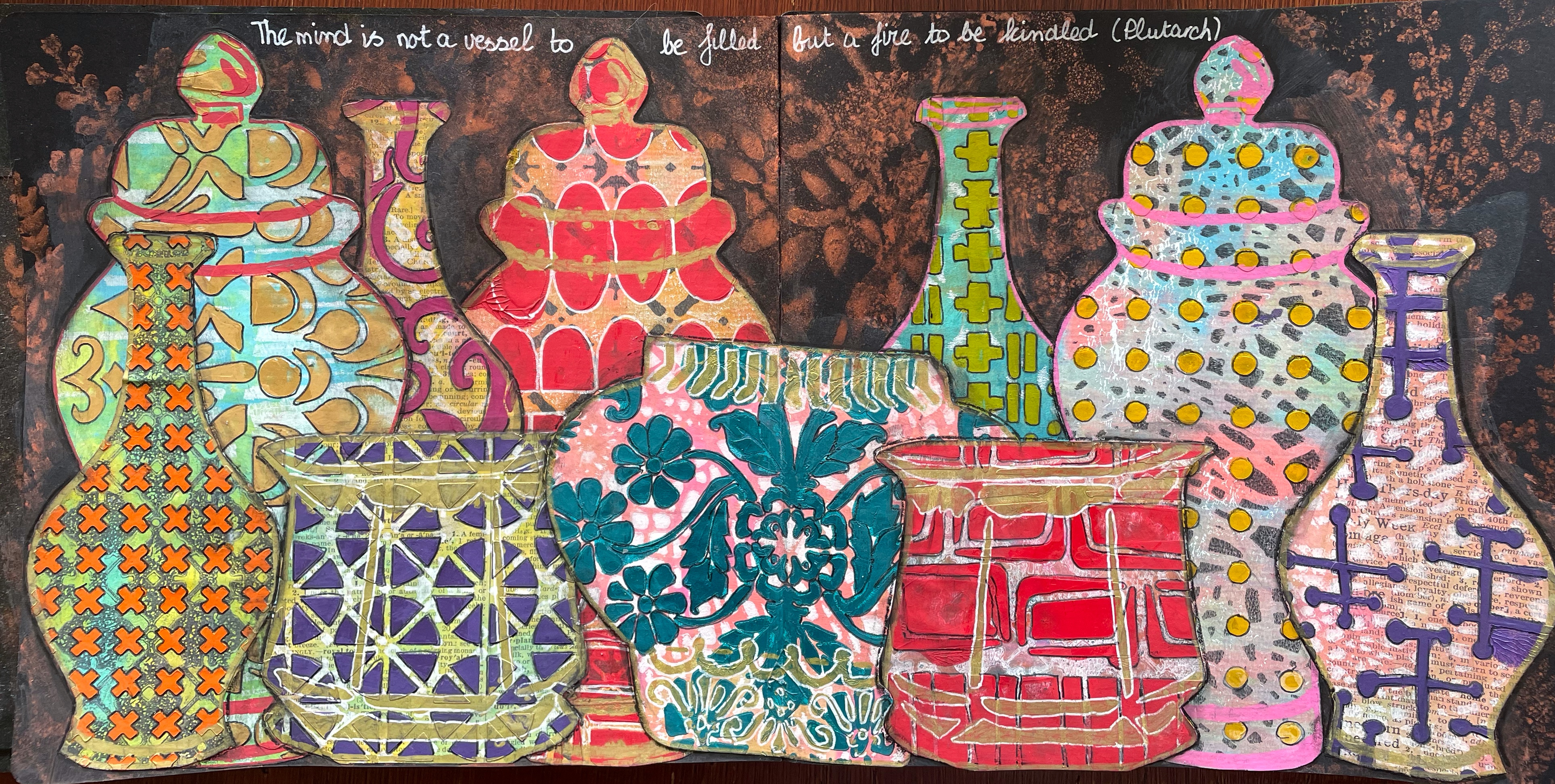
This spread was inspired by an image in an interior design magazine that showed a collection of textured vases together in bright colours. I don’t have that many vases so decided to recreate it in an art journal spread instead. Afterwards I found a quotation that really resonated with me, also about vases.

Here is the tutorial:

1.      Start by making a collection of painted pages on your gelli plate by simply brayering one colour and taking prints. You could also simply paint them with a brush. I used papers from an A4 Artist’s Block (Crelando) that are just a bit sturdier than copy paper. I also added some vintage papers to be painted.

2.      Again using the gelli plate with either black or white paint, add background patterns to the sheets from step 1, using Crackle, the large stencil from the February 2018 StencilClub, and Corrugated Lines Large.

3.      Using Jardiniere outline and cut out a collection of vases and make a potential lay-out. Use the stencil again to outline vases on your painted papers with a black marker.

4.      Apply different colours of Stencil Butter through a variety of stencils to the marked out vases. There are many stencils available to do this with but here is my selection: Waterfall, the large stencil from the July 2019 StencilClub, Daisy-May Tile, Grunge Marks Collection – Grunge Strips and Borders, the large stencil from the August 2018 Club, Loopy Leafy Vines, Circles Layer MeWheel Spokes Set #2 and X Rows.

5.      Cut the vases out on your marked lines.

6.      Using the vase masks from Jardiniere add stencilling with a contrasting colour using Posca pens or any other paint pens. Also edge the vases with the same colour. Outline the shapes on the vases with black and white markers.

7.      Spray paint the background using Tall Flowers, and Perfect Pearl Mist in copper. I used an 8 x 8”  Dylusions art journal with black pages.

8.      Play around with the vases and the lay-out made in step 3 and see if you are happy with it.

9.      Glue on the vases to the background using matte medium and write on the quotation using a permanent white marker.

© Frieda Oxenham 2022. To see more of Frieda's work, please visit her BLOG.

Tuesday, April 5, 2022

Wooden Shoe Love a Pair? How to Make Paper Clay Molds with Stencils and Carving Rubber


Hi Friends.  It’s Jill McDowell here sharing another way to use stencils in your upcycled, art, and home decor projects.

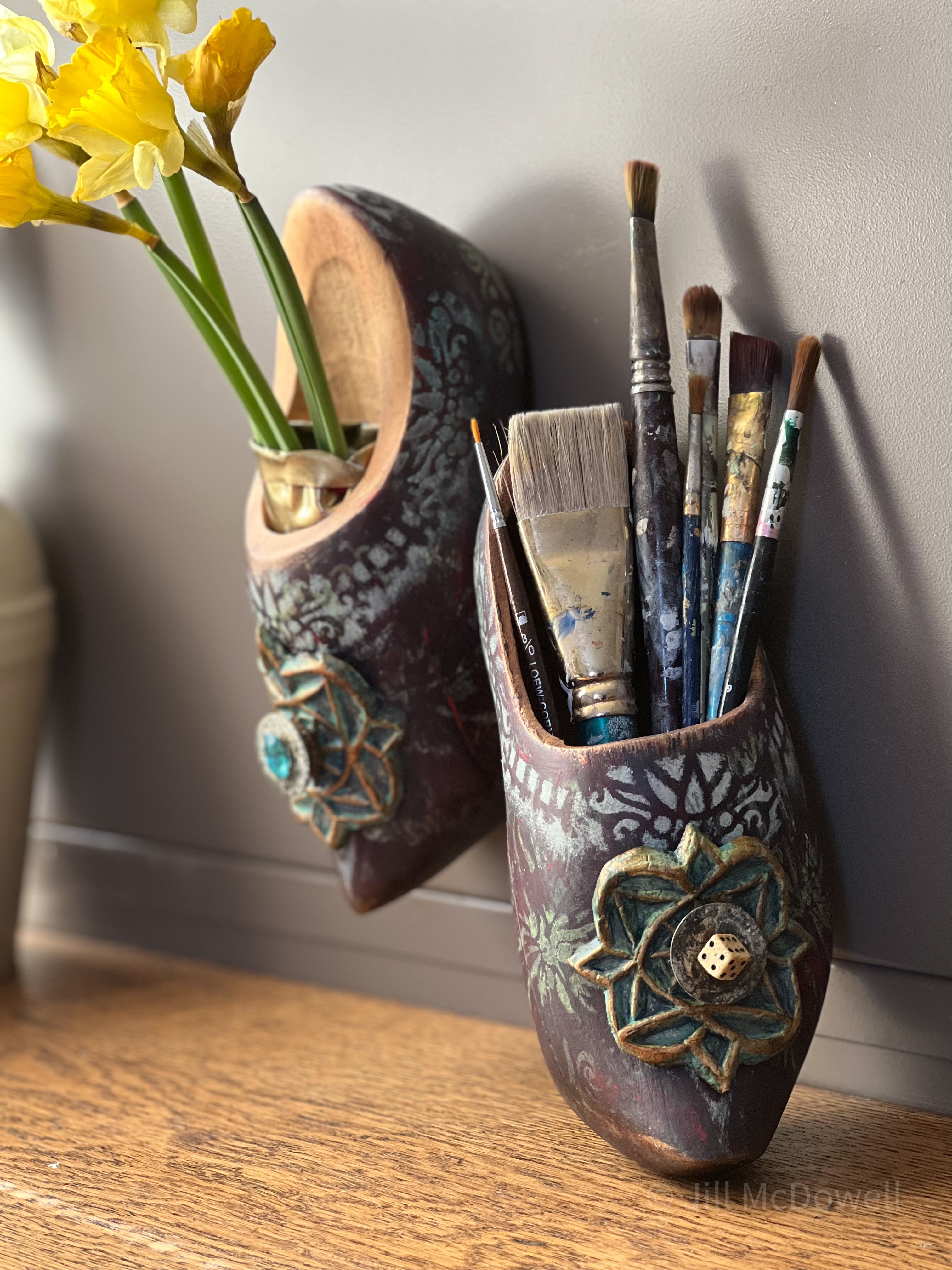
I recently had one of those rare a-ha ‘peanut butter meets chocolate’ moments when I spied on my work table a package of Paper Clay sitting on top of a package of Carving Rubber.  I started experimenting and discovered that YES, you absolutely can make a mold out of rubber and then use the mold to make a pair of paper clay shoe buckles.  Who knew?  Keep reading and I’ll show you how I used my own Four Bells Trivet stencil to do it. And as a bonus, I’ll also share how I turned a wooden shoe into a vase by repurposing packaging from a common bathroom toiletry item.

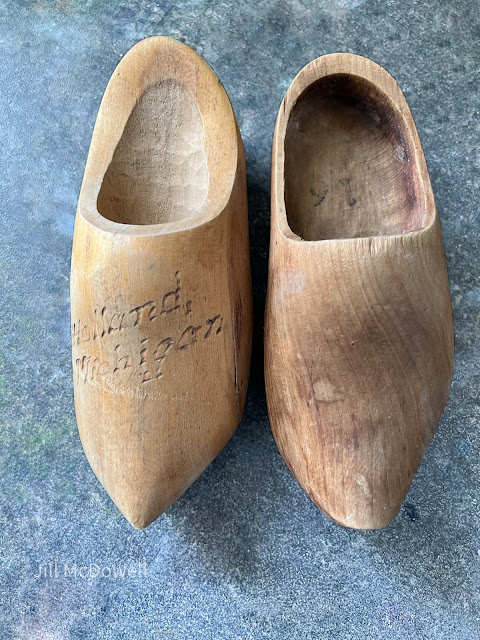
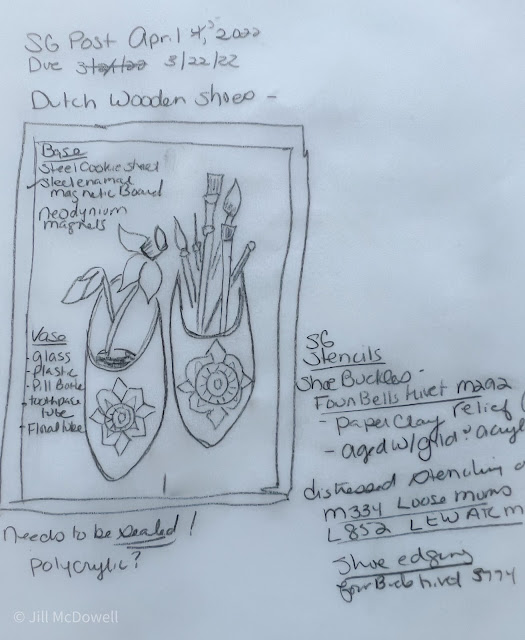
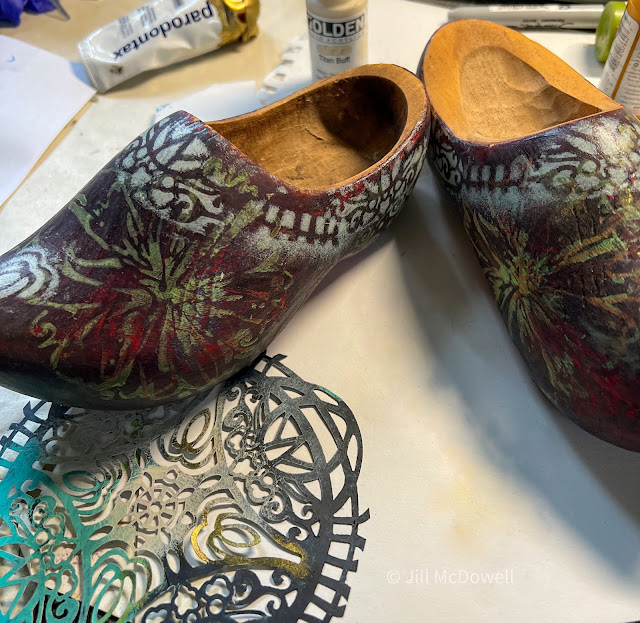
Previous to my a-ha moment, I had scored a child sized, mismatched pair of wooden shoes at the thrift shop.  One shoe was clearly an old souvenir, while the other, stamped Holland on the bottom and the number 16 in its heel, proffered to be an authentic Dutch Wooden Klompen.  (Don’t you just love how the word Klompen rolls off your tongue?). I gave myself permission to repurpose both clogs since a quick check online turned up a rather large number of wooden shoes available for sale.  Turns out wooden shoes are neither rare nor precious artifacts to anyone except us creators.


At $1.99 each, (a wapping $3.18 for the pair after my Senior discount) these wooden shoes were an absolute steal so I scooped them up and into my cart.  Back at home, I poured over Pinterest in search of nuggets of inspiration down that rabbit hole known as cyberspace.  (No sense in reinventing the wheel if I can find a way to put my own spin on a good idea….) And I pulled together an Wooden Shoe inspiration board on Pinterest .  Check it out for more wooden shoe upcycling ideas or if you just want to feast on some yummy eye candy.

Inspiration under foot, (pun intended) I set about developing a plan to repurpose my shoes.  I appreciated that they were an odd couple and decided to subtly exploit their mismatchiness, (ok, I confess that I may have just made that word up to frustrate spell checker).  I liked to think of them as a matched pair who let their distinct personalities blossom during their senior years.  
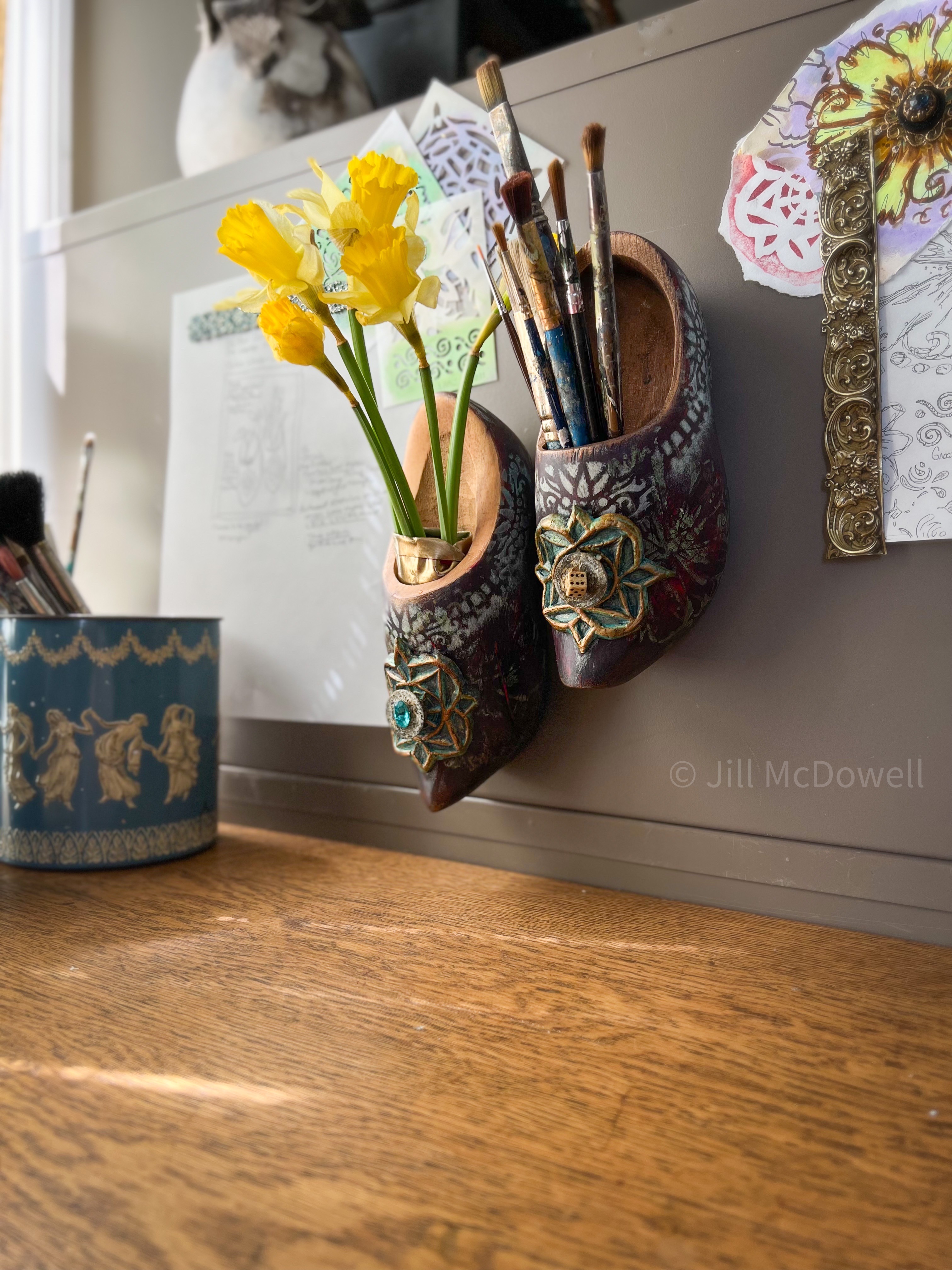
Eventually, I opted to fashion both shoes in an old vintage style with big honking aged metal buckles. One shoe, I’m calling the artist, would become a vessel to hold paint brushes while the other, the naturalist, would be transformed into a flower vase. Ultimately, I wanted them to live together on the magnetic inspiration board I have in my art room, (LOL, It’s really just the side of my flat files). 

So let’s get on to the actual making….

How to make a Mold from your Stencils with Carving Rubber Blocks

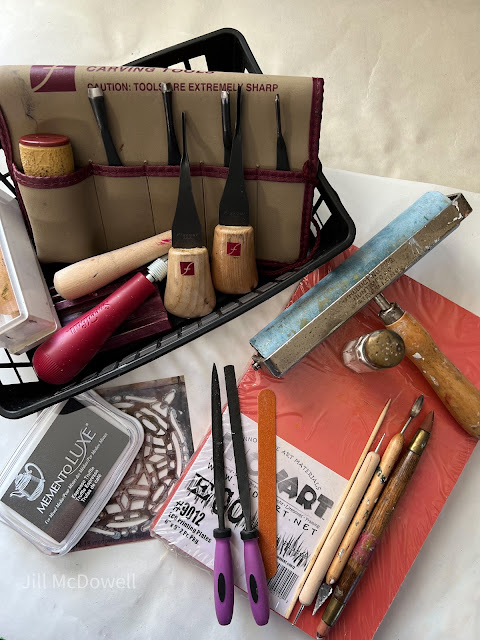
Tools and Supplies

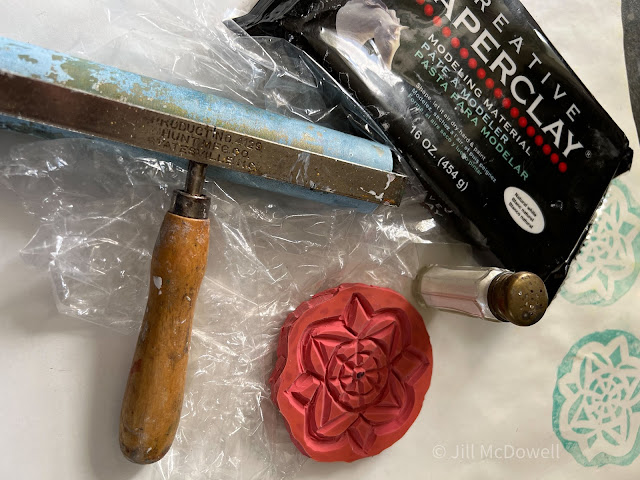
Clockwise from top left: 
  • Carving tools (I have a variety of tools in the basket, all work but my go to favorites are my Palm and Micro carving tools made by FlexCut); 
  • A rubber carving block, (I’m using an Inovart Eco Karve Printing Plate.  It’s both thick and easy to carve); 
  • A brayer, (I picked up this vintage one a a thrift store a few years back.  A rolling pin, smooth bottle or can would also work to roll out the Paper Clay); 
  • Corn starch (I like to keep mine in an old salt shaker.  Baby powder is a good substitute if you don’t happen to have any in your pantry); 
  • A variety of clay shaping tools, (use whatever you have - the end of a paintbrush, an orange stick, a pen cap, anything that will help you smooth the clay); 
  • Metal files, an Emory board, or sandpaper* to smooth the edges of your pieces once it’s dry;
  • A stencil, (of course I recommend StencilGirl®️ Stencils); 
  • A stamp pad and your choice of ink applicator* (I used a cosmetic wedge);
  • A Sharpie Marker*; 
  • A craft knife * used to cut the rubber;
  • Air Dry Paper Clay*, ( I used Creative PaperClay Modeling Material but most any brand of air dry clay will work);
  • A piece of thin plastic*, (I recycled a bag from the dry cleaners);
  • Key: *=not pictured

Creating the Mold from Rubber

Before we get into actually carving the design, let’s go over a few notes on carving safety; 
  • Always remember that carving tools are extremely sharp and should never be used without adult supervision.  
  • Always carve with your hands pointing away from you to avoid being cut if the blade slips.
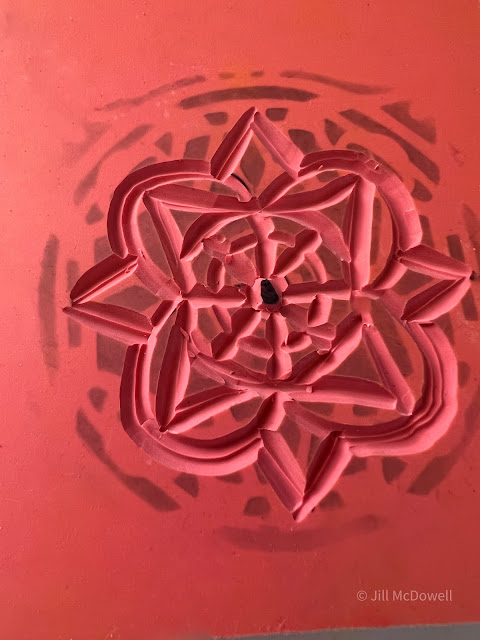
Carving a mold is similar to carving a stamp.  You’re just carving deeper into the rubber knowing that the area you carve out will become a relief printing. This means that any marks on the bottom and sides of your channels will show when you fill it with clay and unmold it.

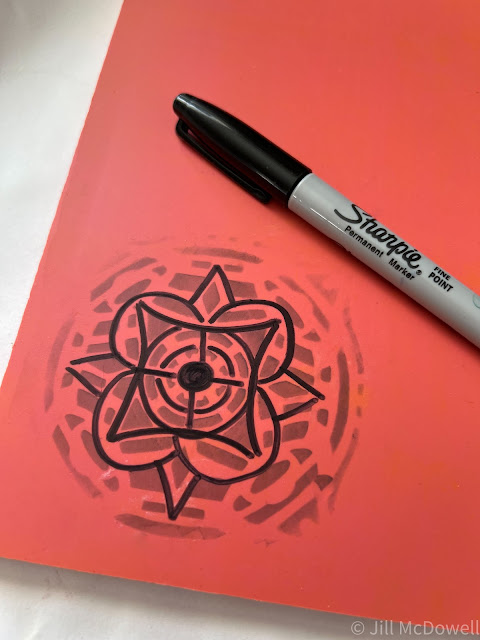
I choose to use my Four Bells Trivet  to create my shoe buckles.  Then I began making my mold by applying ink onto a the surface of a rubber block with a cosmetic wedge.  I used a Sharpie Marker to designate where I wanted to carve out the channels of the mold. (Keep in mind that you don’t need to carve the entire design; you can pick out just the shapes and patterns that work for your project.)

Thencarved into the rubber block, making the channels wide and much deeper than I would have had I been carving a stamp.  The deeper you carve into the rubber, the taller your element will be.   I’m being careful not to carve all the way through to the other side.
This mold is close to being finished.  Since I’m going for a vintage look, I’m perfectly happy leaving nooks, crannies and rough patches in the channels knowing that the imperfections will show in the clay when it’s unmolded and painted.  Once I was satisfied with the mold, I cleaned out any excess rubber pieces left in the channels with a stiff brush and then using a craft knife, I cut the mold from the big block of rubber.

That was pretty easy!

Molding with Paper Clay

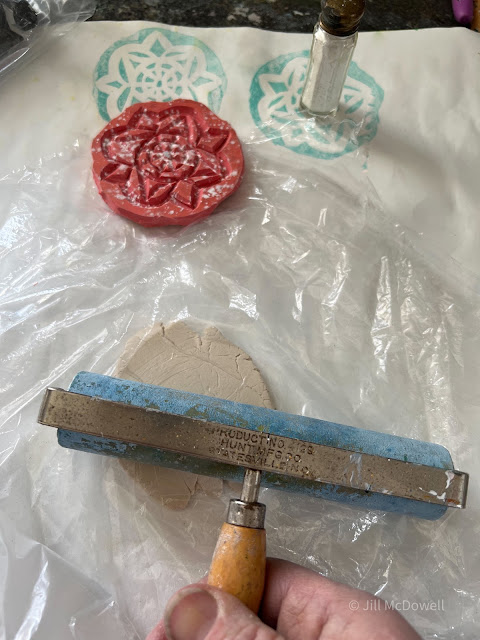
I took a small piece of clay out of the package, rolled it into a ball, sandwiched it between two pieces of thin plastic, (I recycled a dry cleaner bag for this purpose), and used my brayer to roll it out to about 1/4 inch thick.  You’re aiming for an even, smooth finish with no cracks that’s just under the size of your mold. (Be sure to keep any clay not being used in a sealed plastic bag along with a wet baby wipe to keep it from prematurely drying out.)
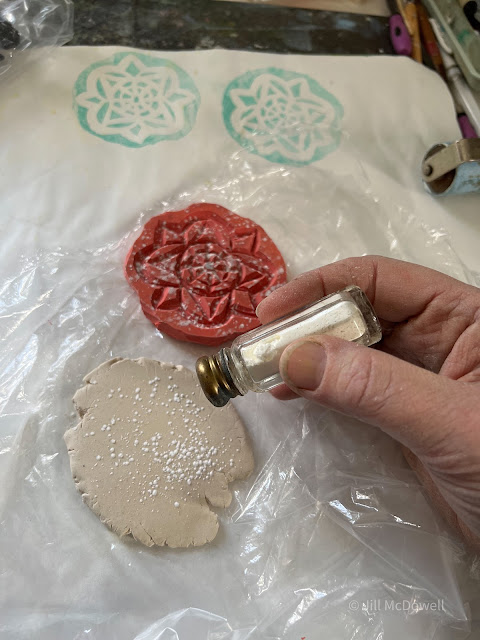
Then I sprinkled both sides of the clay and the mold with a dusting of corn starch to keep the clay from sticking to the mold.
I used my brayer to roll the clay out over the mold and gently pushed it down into the carved channels. 

There is no need to wait to unmold the clay. Just gently pull the clay away from the rubber using a rolling motion. 
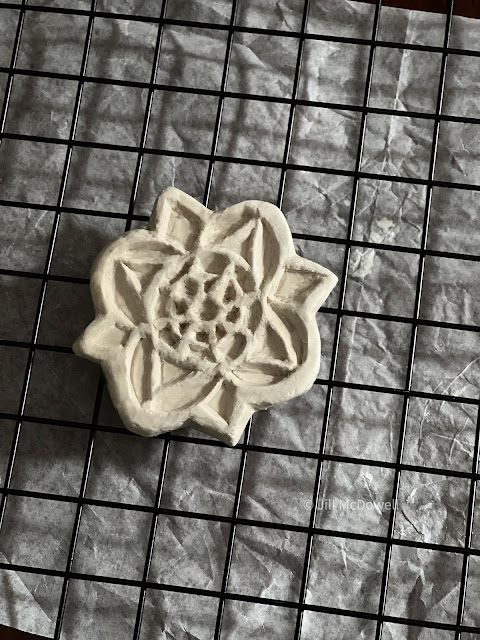
Here’s what the clay looks like fresh out of the mold.  If you’re not happy with what you see, no worries just roll it back up in a ball and re-roll it. If you need to make adjustments to your mold you can go back and carve in more details, but just remember once it’s gone you can’t put it back, so I advise moving slowly.  

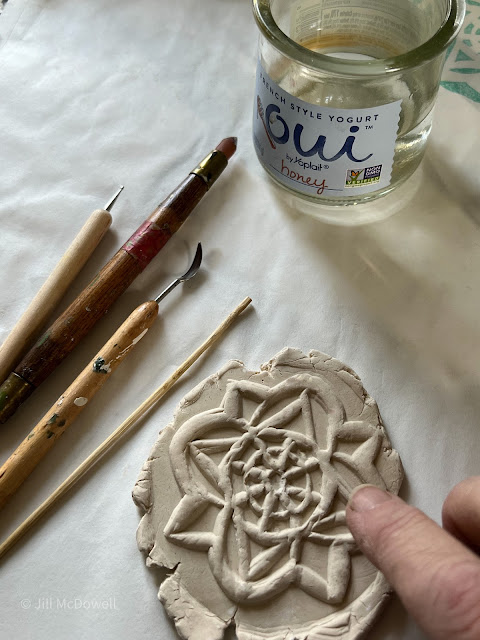
Once I was satisfied with my relief print, I started cleaning up the clay.  I wet my finger and used it to gently smooth out any cracks then used my clay shaping tools to crispen up some of the details.  (You can also add additional texture with the clay tools at this point.) Finally I used a craft knife to trim the edges of the buckle into the shape I wanted and then smoothed the edges with my wet fingers.  Keep in mind, the more smoothing you do now, the less sanding you’ll need to do once it’s dry.  
Normally I would set the piece on a wire cooling rack to dry, (be patient as this could take several days depending upon your climate.). You’ll know its dry when the clay no longer feels cool to the touch.  If your piece begins to curl out of shape you can ‘lightly’ mist it, and then cover it with a piece of deli paper and a book (not too heavy) to weigh it down. Let it sit overnight and it should flatten out in a few hours.

However for this project I wanted the buckles to hug to sides of the shoes.  So I molded them over the shoes and let them dry. While the drying process takes longer this way, the fit will be perfect when it’s time to glue the buckles onto the shoes.

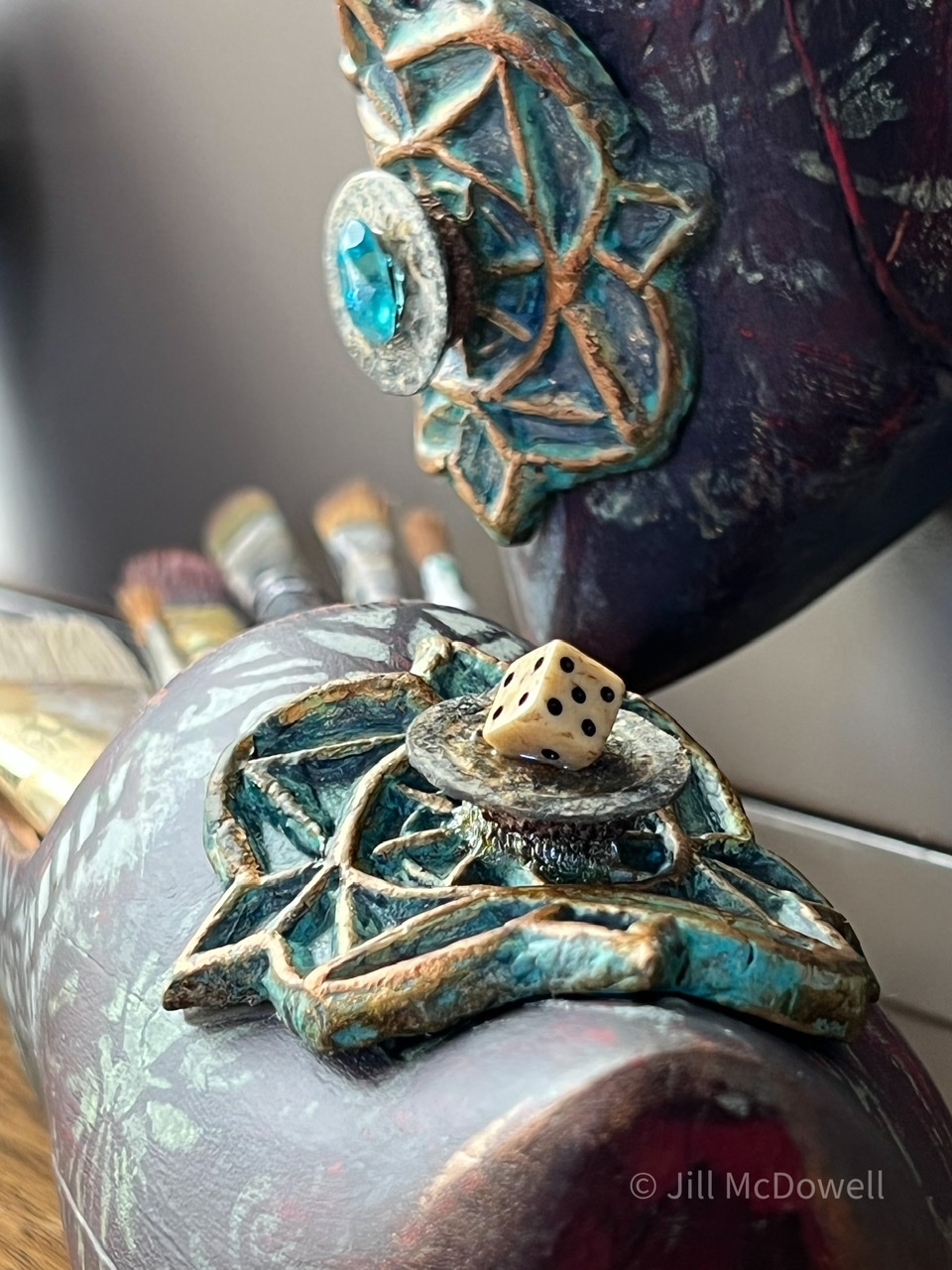
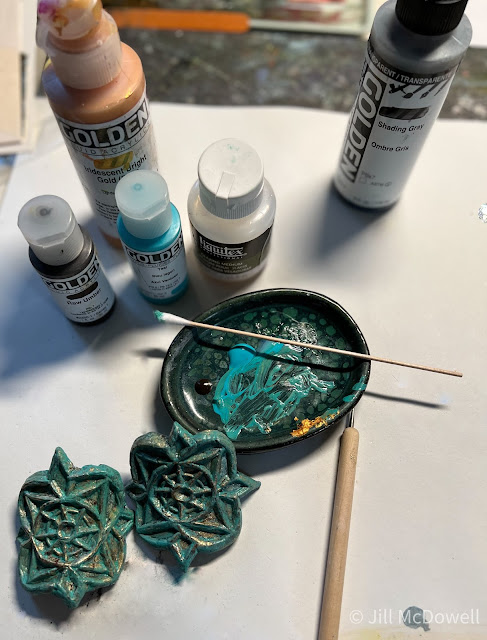
Once the buckles were fully dry, I sanded all the rough edges with a file, (you could use an emery board or sandpaper) and then set about aging them with acrylic paints and waxes.

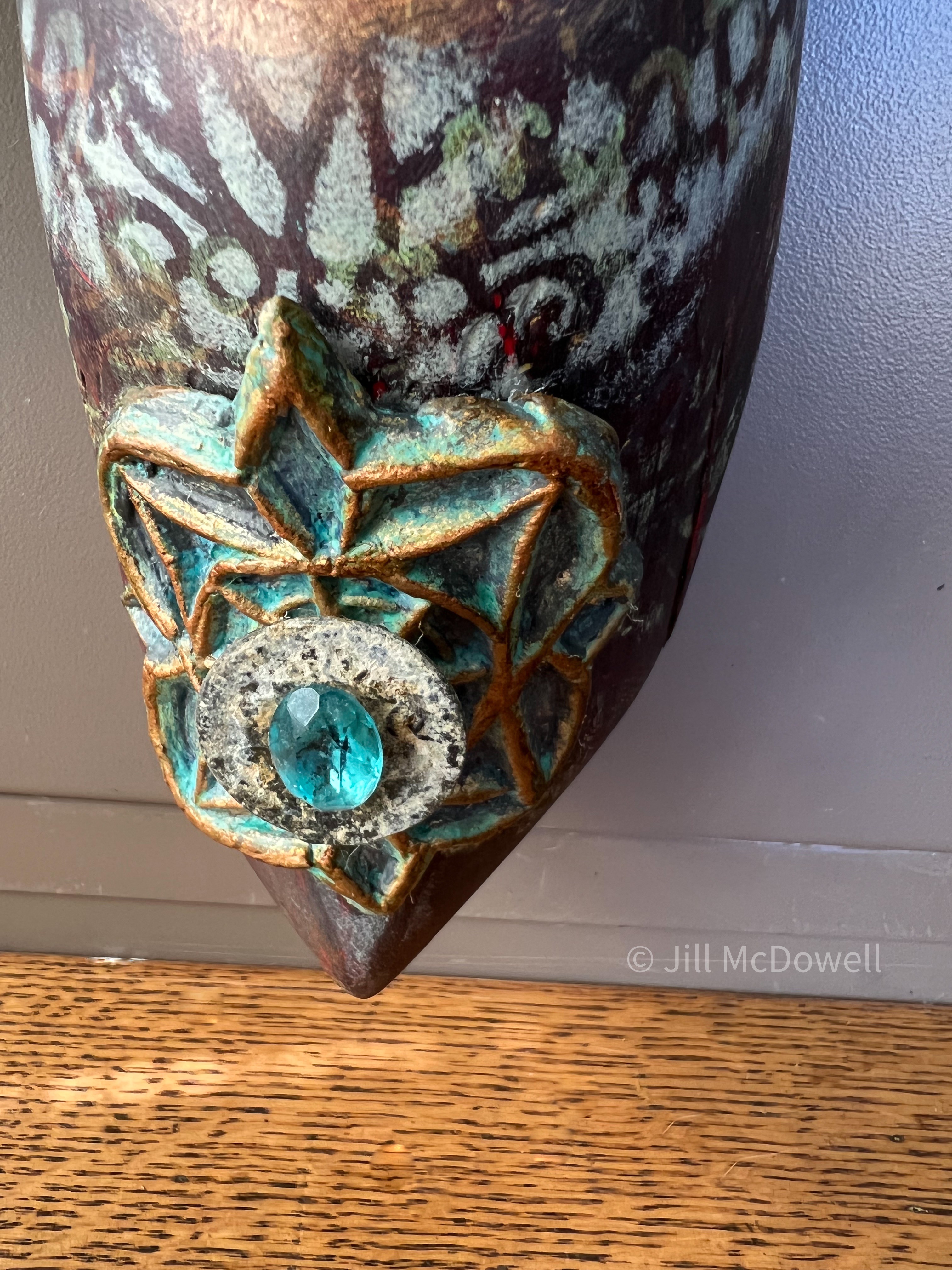
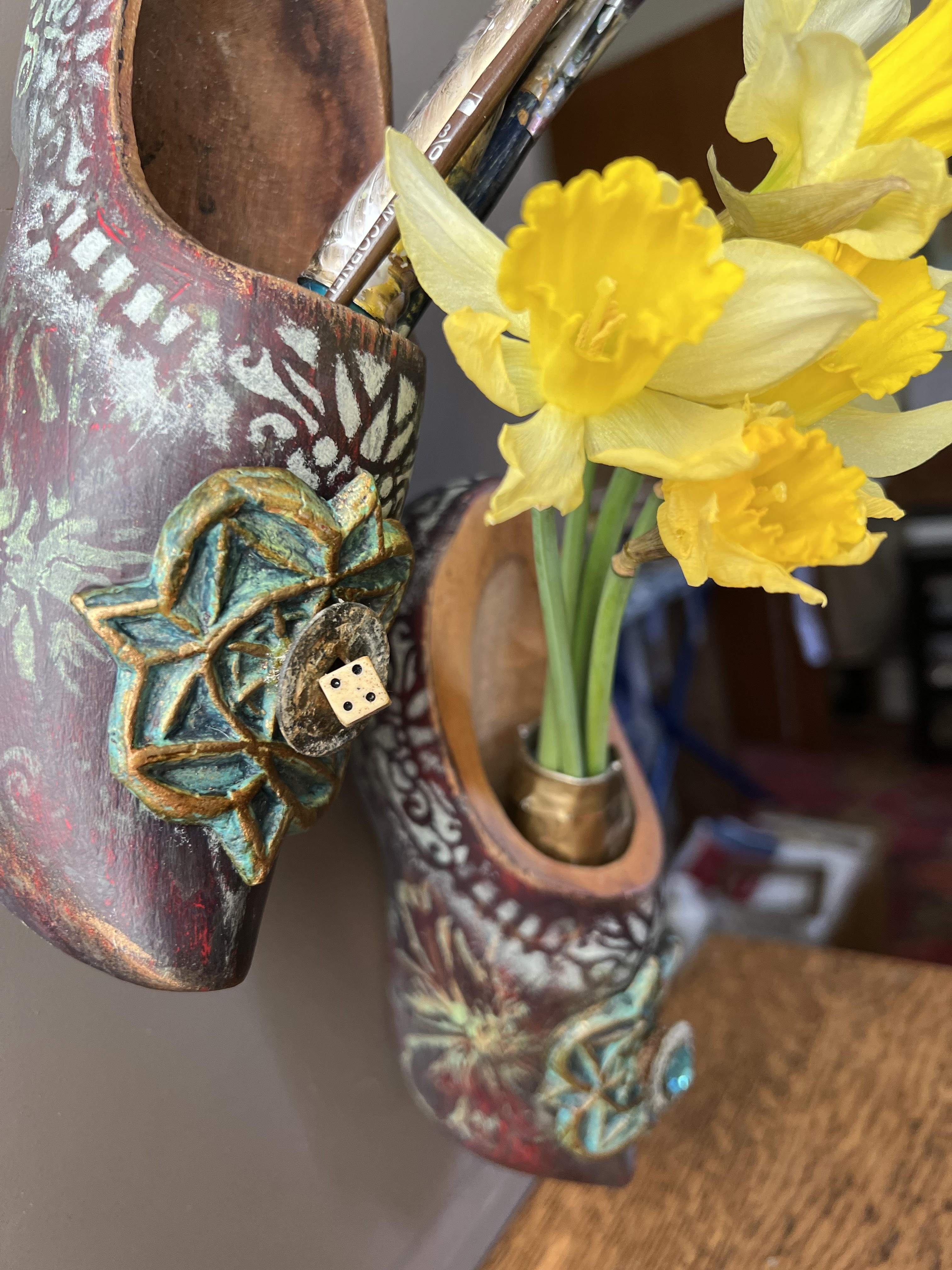
I dug through my stash to find the perfect embellishment befitting their unique characters for each buckle. I wanted them to sit high off the buckle so I raised them up with and acorn cap.  


Transforming the shoes 

I used these four StencilGirl®️ Stencils in this project, two of my own designs; my Four Bells Trivet  (for the buckles) and my Four Buds Trivet stencils, along with two Linda Edkins Wyatt’s designs; her Loose Mum Stencil and a sweet little motif pattern found at the very bottom of her ATC Mixup which I used to dress up the back of the heels.

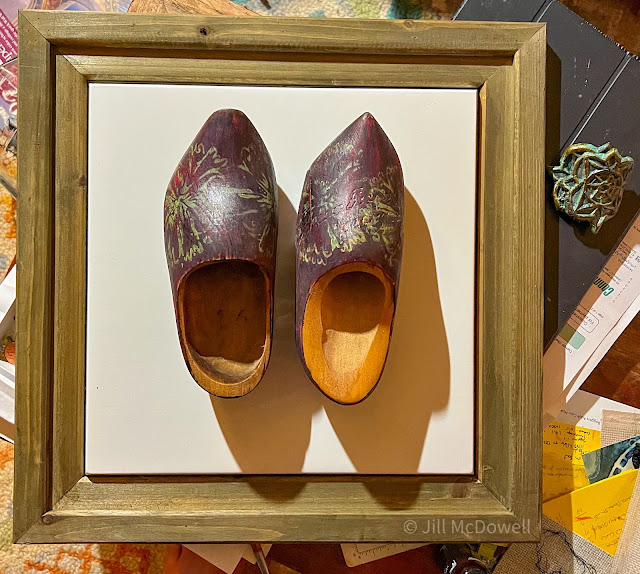
I lightly sanded and then painted the shoes with red gesso.  Then I just kept adding glazes tinted with a mixed of purple, gold, and brown until I got the worn vintage look I was going for.

Then I stenciled them using Linda Edkins Wyatt’s new Loose Mums stencil on the front and a sweet little design I fell in love with from her ATC Mixup stencil to dress up the heels.  I knocked back the stenciling with sandpaper to make the shoes feel worn.  Finally, I dry brushed Titan Buff paint over my Four Buds Trivet to the shoe rims. 

Finishing Touches

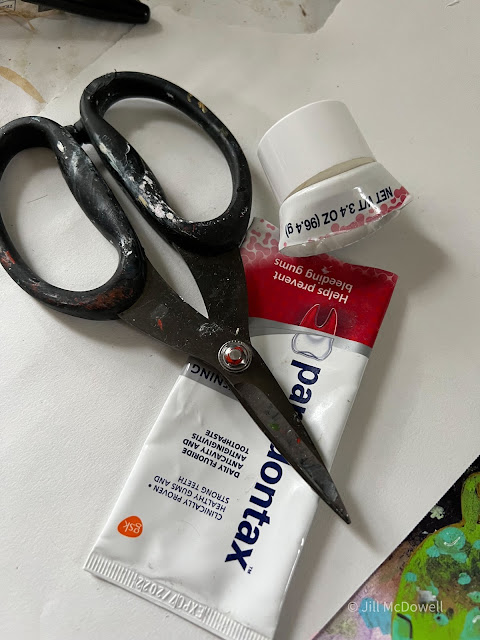
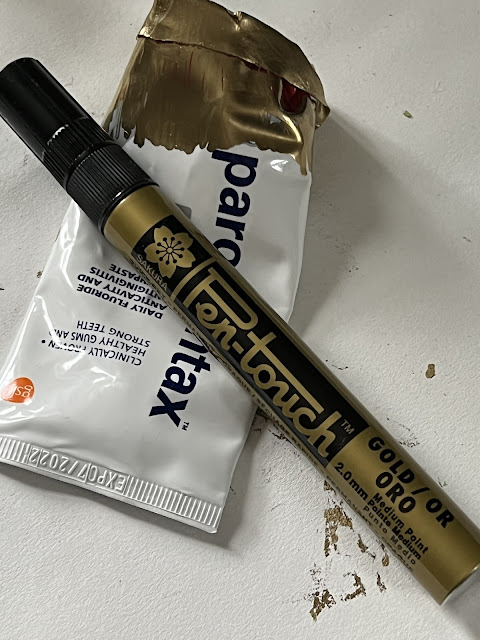
I repurposed a toothpaste tube to line the shoe that was to become a vase. I just cut the top of the tube off, washed out the leftover toothpaste, folded over the top edge to adjust the height, and painted the visible area with a gold paint pen.  It was the perfect solution and cost me nothing!


And lastly, I glued on the buckles; added strong neodymium magnets to the back of each shoe so that I could mount them and move them around my memo board, (which is actually just the sides of my flat files); and sprayed them with three coats of Krylon UV-Resistant Clear Coating to seal and protect the wood.

And that folks is the end of this project. It also draws to the end my time here as a StencilGirl®️ Columnist as I’ve decided to focus more on my family, (I just became a Grandmother!).  It’s a bittersweet moment for me and it’s hard to find the right words to express how grateful I am for the opportunities and experiences I’ve gained representing StencilGirl®️ these past four years.  I’ll always be a StencilGirl®️ at heart.  Thank you all for the support you’ve all shown me over the years.

And with that, I’ll leave you with a few more beauty shots of my Wooden Shoes.  Take care, pray for peace, and keep creating.  Hugs, Jill


Follow me on Instagram at:


Friday, January 28, 2022

Japanese Style Wabi Sabi Gift Box


Servus! It's Claudia here today to share with you a project that was totally inspired by the designs of Japanese Kimono designs and the beautiful StencilGirl® stencils designed by Mary Beth Shaw, Gwen Lafleur, Jill McDowell and Daniella Woolf - a wabi sabi style gift box.


Having two studios in two different locations often means you're in search of specific stuff from your stash and just as often it also means that you're searching for it in the wrong home - but in many cases this leads to inspiring discoveries - or rather re-discoveries - of long forgotten items! In my case that was the unearthing of a poster book with Japanese Kimono designs from one of my quite neglected shelves (while actually searching for posters of H.R. Giger to give to my son for possible reference for his pencil shading exercises). I already had the beautiful Crests stencil designed by Jill McDowell on my desk...


...and I knew I needed a special gift box for my sister's big birthday, so I grabbed a glossy white box that once held plain white greeting cards and envelopes, some DecoArt premium Acrylic Paints, a large round Gel Press Plate and a smaller octagonal Gelli plate, a brayer and some torn to size white deli paper and light grey wrapping paper (used for wrapping dishes for safer transport) sheets, a dabbing sponge and a palette knife and started to play. 

Other StencilGirl® stencils used: 


But before I started my gel plate printing session I remembered to first prime my white glossy box lid with two layers of DecoArt Chalky Finish paint "lace" to not only tone down the cold white and gloss but also provide a bit of texture and tooth for adding paint and gluing the prints on. 


I knew I wanted a symmetrical design and a combination of circle and octagonal shapes - but not as parts of a clean and simple style project! Going for a symmetrical composition with grunge or wabi sabi style designs kind of emphasises the grungy feel and also contrasts the imperfections of the focal elements. And contrast always means that there is "visual adventure" for the beholder to experience.  Symmetry also is a means to "control" a grungy mixed media design and not let it slip towards that feel of "someone-just-threw-lots-of-cool-stuff-onto-a-canvas-in-a-random-and-messy-way". Well, I think you know what I mean. ;)


Wabi-sabi is a term that comes from a set of believes with traditional Japanese aesthetics and is mostly about the acceptance of imperfection and impermanence. Mixed media and wabi-sabi go together really well - wabi-sabi per definition is never sleek or mass-produced but instead celebrates hand made one of a kind makes. It also focuses on the beauty of nature's imperfections and perishable natural materials - so texture, grunge and weathered are the perfect styles to integrate the concept of wabi-sabi in and enjoy being allowed to work without measuring, precise cutting or having to look for neatness in general. 

I used some of the Kimono designs from my poster book as a reference for picking Japanese style colours.


Then it was finally time to enjoy a good gel printing session! 


I didn't aim for specific results but rather experimented and went back and forth and I also used up any spread paint on my brayer for additional random background prints. 


The paint on the used stencils also got used up by misting the paint left on the stencil and pulling prints directly from the face up stencil. 


That led to an even more wabi-sabi style result I found!


For my focal element I picked one of the randomly layered larger circle prints and added stencilled layers only in sections...


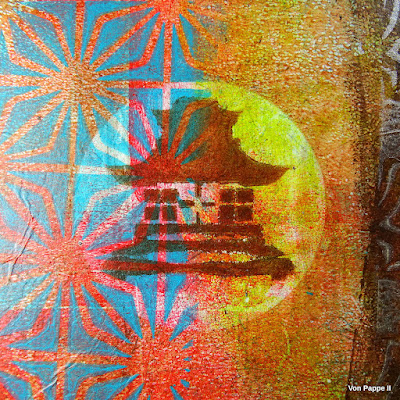
Especially the small circle stencil with the pagoda from the "Crests" stencil was a perfect addition. As the print I had pulled using it wasn't too good, I placed the pagoda stencil in the exact same spot again directly on the print and added a darker layer of Raw Umber on top using a dabbing sponge.


For a more festive look (as it was a big birthday celebration this gift box was meant for) I decided to add DecoArt premium Acrylic "Pale Gold" to the print, using the Moroccan Spa Window stencil again. To make it pop from a darker background I first had to add Raw Umber to the print - but only in the section that I wanted the stencil design to go. 
Needing two tries for this and therefore not getting a straight edge for that part on the print as you can see still got dearly embraced - remember: wabi-sabi is also about embracing this kind of imperfections as these are what distinguish makes as one of a kind hand made pieces from mass produced ones. And that definitely is a quality, don't you agree?
It's not always easy to give yourself the permission to stick with the obviously imperfect - I can tell! - but it is a wonderful exercise in awareness (and you get better at it with each time)! 

Of course the picked octagonal and circle prints couldn't go on a plain white background - too much neatness and too little visual fusing! - so I scraped more Pale Gold onto the box lid with a palette knife, trying to only do loose vertical scraping motions. 


Once that had dried (in the meantime I had roughly (!) cut out the prints I was going to use), I glued the deli and tissue paper prints in place using a wide soft brush and matte DecoArt Americana Decou-Page glue and sealant. I made sure the prints used around the edges also covered the narrow sides of the box lid - this added a lot of depth and interest to the whole design. 


I really love that I managed to capture a true Japanese wabi-sabi feel with my gift box and how all the beautiful stencil designs were all equally starring on the box lid! 


I hope you like this wabi-sabi approach to gift-wrapping! 
Hugs and happy crafting!
Claudia
xxx