I get it. It's daunting.
A mountain of resources —
money for registration fees, supplies and travel, scheduling
time away from work and family, expending vacation days, and
balancing “me time,” with what’s best for everyone else in your life — go into getting away for a weekend to learn and create.
It takes a lot! And, I so appreciate what it takes for someone to even
get to a workshop.
There's anxiety about travel, having the right stuff, being "good enough" to take a workshop, treating oneself, and "will the people there be nice?"
There’s a lot of pressure to make it a perfect experience, make perfect art while you’re there, and walk away with perfect memories… Perfect! except for that “perfection” trap!
Allison Revetta, long-time workshop attendee, mixed media lover & friend, says it best: “
"My advice to a first-time workshop attendee would be to let go of expectations and just relax and let
 |
| What would you have a Billboard flash during your workshops? |
it happen. It is a learning experience and you probably won’t make a masterpiece in class. I look at workshops as information being imputed in to be spewed out in the future (recognizable as that workshop or not). Creativity is a muscle that needs attention and workouts (workshops). There is something about the creative energy in groups that you can’t get working online or alone. It’s the experience of being with like-minded people, the process not the results.”
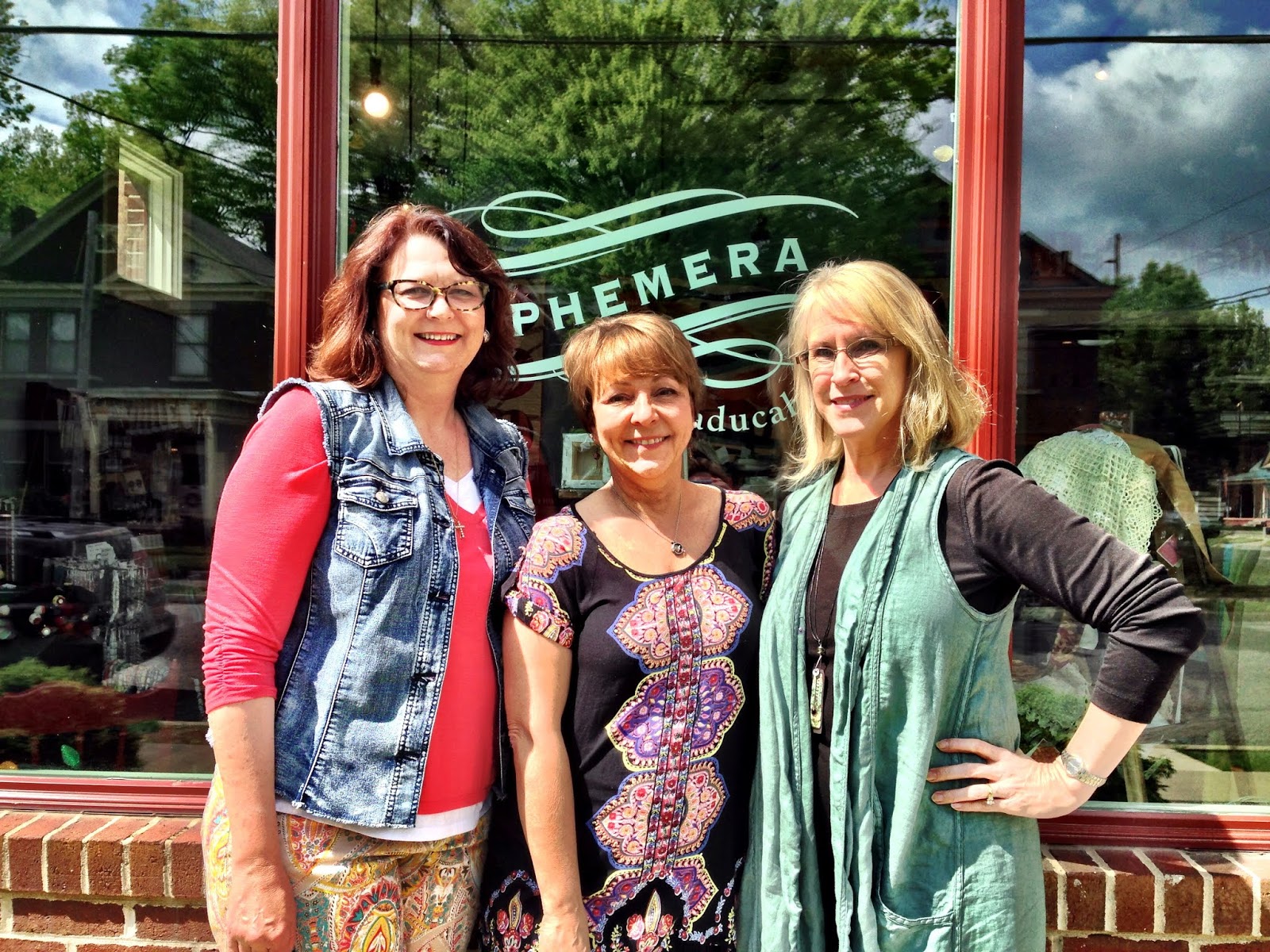
As the owner of Ephemera Paducah, an art & craft workshop space, I have the privilege of hosting hundreds of “Everyday Artists” in my Studio each year. I’ve wanted to write an article or blog post for some time about how to get the very most out of your workshop experience.
It kills me when I see students struggle in workshops whether it’s digging through way too many supplies to find the “perfect” piece of paper or letting comparison rob them of the joy of creating, not acknowledging that everyone is showing up with different experiences, expertise, and years of learning. Dealing with all that emotional or physical stuff distracts from the reasons they are there. I’m hoping this piece can help someone get more out of a workshop they’ve looked forward to, planned for financially, and set high expectations on!
Below is a list of ways to help make your workshop experience as wonderful as possible. And, I asked some trusted advisors of experienced workshop attendees and Artist-instructors for their thoughts. I hope this gives you the confidence to take the plunge and enjoy creating & learning in a room full of people as I think there’s nothing like it in the world.
Suggestions for a Great Workshop Experience
Connect
The great news is you’ve already got one in thing in common with your fellow workshop attendees! Art! If you don’t have an “Art Buddy” to travel with, go anyway knowing you are going to find “your people” at the workshop. If you are on the fence about traveling alone, take the dive. When someone says, “who wants to go to dinner?" say, "YES. I do!” If there’s a Facebook group or pre-email from the venue, put yourself out there and start getting to know your fellow attendees.
Veteran workshop attendee, Lisa Visel, says,
“What do I think of when I think 'workshop?' Excitement to learn and make something in a group setting. Meeting people, old friends and new, to have fun with and laugh with. Nourishing my creative soul with something (probably) new.”
Scarlet Fields makes the same point based on her experiences attending workshops,
“Don’t be nervous; these are your people! Allow yourself to be a student. Give up perfection. Work hard, play hard. Ask questions. Introduce yourself to someone new every day-really introduce yourself. Be open to all of the delicious energy.”
Supplies
Denise Hug, a former shop owner and lover of workshops says,
“you don’t have to bring the kitchen sink.”
 |
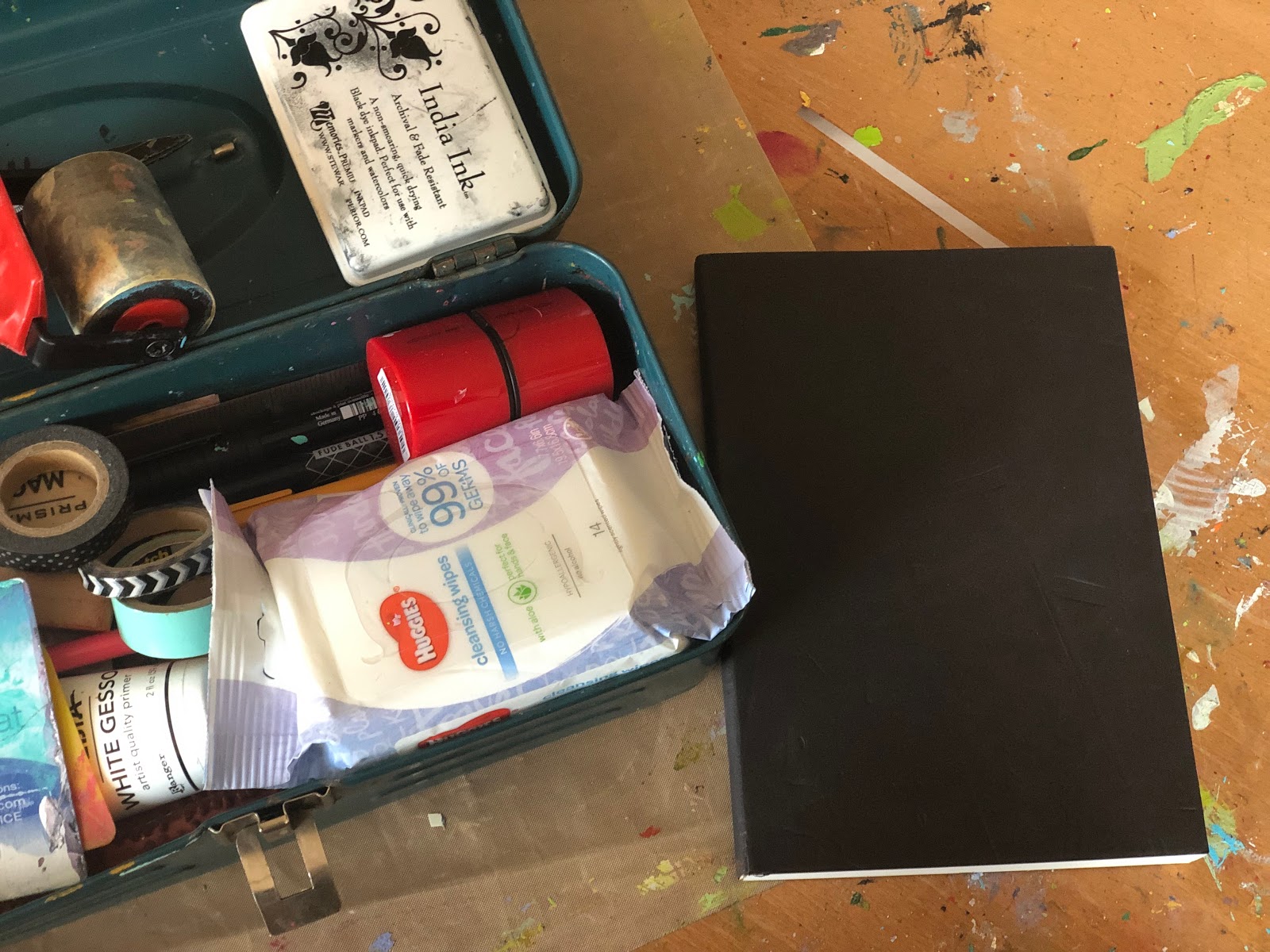
| Regardless, bring a small journal |
I admit it. I’m not a minimalist. And, I used to do it. I remember mailing two (2) 50-pound boxes of supplies to a retreat I was attending in Las Vegas many moons ago. Did I touch 95% of that stuff? Oh, heck no! Did it weigh down my experience as I man-handled it to the room? Create stress about how to get it back home? Still consume my psyche with, “do I have the right stuff??” Oh, heck yes. It. sucked.
Bring the items on posted supply list (in minimal quantities) and your Basic Kit, and that’s all you need. Seriously. That’s all you need. And, know that people who attend workshops and retreats are nice. They share. I truly believe from personal experience that one learns more the less she has to dig through “stuff.”
 |
| Basic tool kit fits in here. |
Here’s my basic supply kit:
craft mat
small journal (regardless of the class great for notes or swiping extra paint in)
favorite black & white pens
black Stabilo pencil
regular pencil
eraser
small ruler
white gesso
2-3 of your favorite washi tapes
matte or gel medium
India Ink stamp pad
a few stamps
6-8 paintbrushes
sponge
pouncer
small empty spray bottle
brayer
old hotel key card
yellow scraper
bone folder
palette knife
scissors
glue stick
a small pack of baby wipes
and of course stencils (I travel with the 6 x 6 or smaller sized ones)
Yours may be different. These are the items I know I’ll grab in any mixed media workshop.
Comfort
Anticipate what you might need to be physically comfortable. I can tell you once you get more than 3-4 people in a room, it’s impossible to make everyone happy with the temperature. You know whether you run hot or cold, or, if you’re like me, one minute hot and the other cold. Don’t risk being miserable due to room temperature or other accommodations where you will be sitting for 3 days. Dress in layers and throw in that sweater! Bring a pillow for your seat if a folding chair makes you sad.
If you have a mobility challenge or physical need, please contact the shop or venue ahead of time to understand what accommodations can be made. We want you happy and comfortable and will bend over backward if we know what’s needed.
Headspace
Maybe the hardest thing
NOT pack (but try, try, try) is your inner critic. Perfection is not reality.
 |
| What would you have a Billboard flash during your workshops? |
Glenda Miles advises:
“Honor the “pre-retreat” You; seeker of self-care and creative escapades and carrier of responsibilities, worries, and expectations. Welcome “post-retreat: You; proud accomplisher of goals, friend maker and newly expanded, nourished and connected artisan.”
“People are at different levels of experience so don’t compare your work with someone else’s because you may be at the beginning and they may be further along the learning curve. Perfection is the enemy of creation sometimes.” Janis Graham, workshop attendee.
I think the worst saboteur of enjoyment is the comparison to others and feeling unworthy in a workshop. Many of my advisors noted it in some way or another with their answers.
Gwen Lafleur:
“A few years ago I took a workshop with a teacher whose style was very different from mine and had a huge epiphany... once I learned to use the ideas and techniques with my own style rather than trying to emulate the instructor, everything became even more fun and I now take away so much more from the workshops I attend.”
Andrea Chebeleu,
“‘Comparison is the thief of JOY’ (quote by T. Roosevelt) Don't allow your joy to be stolen by comparing your work, your supplies, your anything to your neighbors. Enjoy the process and try to be present and soak it up.”
 |
| Mary Beth Shaw as a workshop attendee (with Otis) |
Joanne Sharpe:
“Baby steps. If this were your first piano lesson, you certainly wouldn’t be playing a Mozart concerto!”
Peg Riley gives this advice:
“When a fellow student is struggling or feeling like his/her work is ‘beneath’ everyone else’s, that’s the time he/she needs to pause and take a walk around and look at other work. I'd suggest they talk to the instructor about different ways to achieve their goal.”
Go into the workshop giving yourself permission to learn, to make mistakes, and know that the experience is enriching you. Don’t grade it on your ability to match your own unrealistic expectations.
Scarlet Fields says,
“My heart aches when I see a student get caught up in the creative decision-making process, so caught up that they can’t make a decision at all. I want to say close your eyes, take three deep cleansing breaths, clear your mind, open your eyes and choose the first thing you see. This isn’t your last and only creative project, it is the one you are exploring now. Go down the rabbit hole and be Alice.” I love that. Be Alice.
Jenny Doh has a
blog post that is profound about being responsible for the energy you bring into a workshop. Or, put this quote on your supply list:
“Take responsibility for the energy you bring.” ― Jill Bolte Taylor
Interact
You’ve got at least one expert in the room. Ask questions and get to know the teacher. Learn from your classmates, as well.
Carolyn Dube:
“Ask questions and talk! Ask lots of questions- you’ve got that instructor right there and that is a big part of an in-person workshop and talk with your fellow classmates. Get to know them and their journeys. Such diverse paths lead people to art!”
Pam Carriker:
“Have fun. Get to know other creative people and learn from them as well as the instructor. It can be very inspiring seeing how everyone interprets the techniques. Don’t be afraid to ask questions! What is old news to someone else may be brand new to you. It was brand new to all of us at one point or another.”
Physical Space
I jokingly (kind of) talk about traveling to workshops with a high school friend who I'll call, "a creeper." We'd be working away at the same table when I'd look up and see that she was taking up 7/8s of the space while I was working in mere inches.
Don't be a creeper. Keep an eye on your stuff so that no one trips over it. Be attuned to your personal space and surroundings and the people at your table will appreciate it so much.
The same deal goes for showing up on time but please, not too early. Understand that teachers need those zen-filled moments before the workshop opens to prepare for you -- mentally, physically and emotionally.
Valerie McCoy from Memphis summed up a lot of good advice in her answer: “Read the supply list and study the instructor's work prior to course. Don't bring your entire craft room to a class. Be on time. If you disagree with an instructor's response, carry on later on the topic during a break or something. Support the local shop owner. If you know an item is less elsewhere.. don't make a big announcement.. just keep in mind it is important to support small businesses.”
Stencils
What would a StencilGirl Column be without mentioning Stencils??? I asked my trusted advisors what their favorite Stencils are to bring to workshops. Here’s the lowdown!
Cathy Nichols: I really enjoy using my
sun and moon stencil because it adds just that extra pop of symbolism to oracle cards!
Gwen Lafleur: That depends on the workshop, but a current favorite generic stencil that I use in most of mine would be the
Collage Textures and Patterns, Circles stencil.
Glenda:
All of Pam Carriker’s Halo Stencils —Faithful, Radiant, Creative and Beautiful all representing a sacred circle beckoning and welcoming us into a reclaimed ancestor art story.
Cathy Costelle: Just one, next to impossible?!?! I like to use stencils that help create interesting backgrounds and textures and that will depend on the class project.
One of my favs is Seth Apter’s Numbers stencil and Timeless stencil.
Lisa Visel - *all of them? Lol. I like to bring a variety of sizes and designs because I never know what I’m going to want. Mainly my favorites are small designs to use as texture.
Debi Adams - Stencilgirl stencil...hmm. That is REALLY hard. I use Seth's and Mary Beth's a lot, but I never leave home without
Rae Missigman's Repetition stencil. <3
Mary Beth Shaw:
My Grid set
Allison Revetta - I never leave home without my
Rae Missingmen small stencils. The repeating dots is my go to plus arrows, triangles, flowers... all Rae, all the time
Carolyn Dube -
Wall of Words - I love adding text and it is so versatile for doing a background, adding a title, or just a little random word here or there.
Pam Cariker - One of my favorite stencils continues to be the
color wheels. You can learn so much from playing with color and they are such a great visual image.
Valerie McCoy -
Carolyn Dube's Wonky Eyes stencil
Julie Snidle - My favorite SG stencil is the
Scribble Scratch Handwriting stencil.
Janis Graham - That changes with what I’m doing, but for words,
Words to Live By”. For making backgrounds it is hard to beat the 9x12”
ATC stencil #2. It gives so many different patterns on one stencil. My personal current favorite stencils are the spirit wind masks.
I like Carolyn Dube’s “
Scarlet Fields - I have become very fond of the back groundish stencils and since Mary Beth told me I could cut them up, I use them more.
Peg Riley - I don’t know the name of it, but it’s SC-01-2017…has many design elements on it…
Thank you to all my trusted advisors for their great advice. And THANK YOU to the teachers and students who travel to Ephemera Paducah.
I hope this gives you some ideas and the push you to put “take an art workshop” on your 2019 New Year’s Resolutions List!
oxoxo
Kristin Williams