Showing posts with label art workshops. Show all posts

Monday, November 21, 2022

A Gentle Reminder about Workshop Etiquette


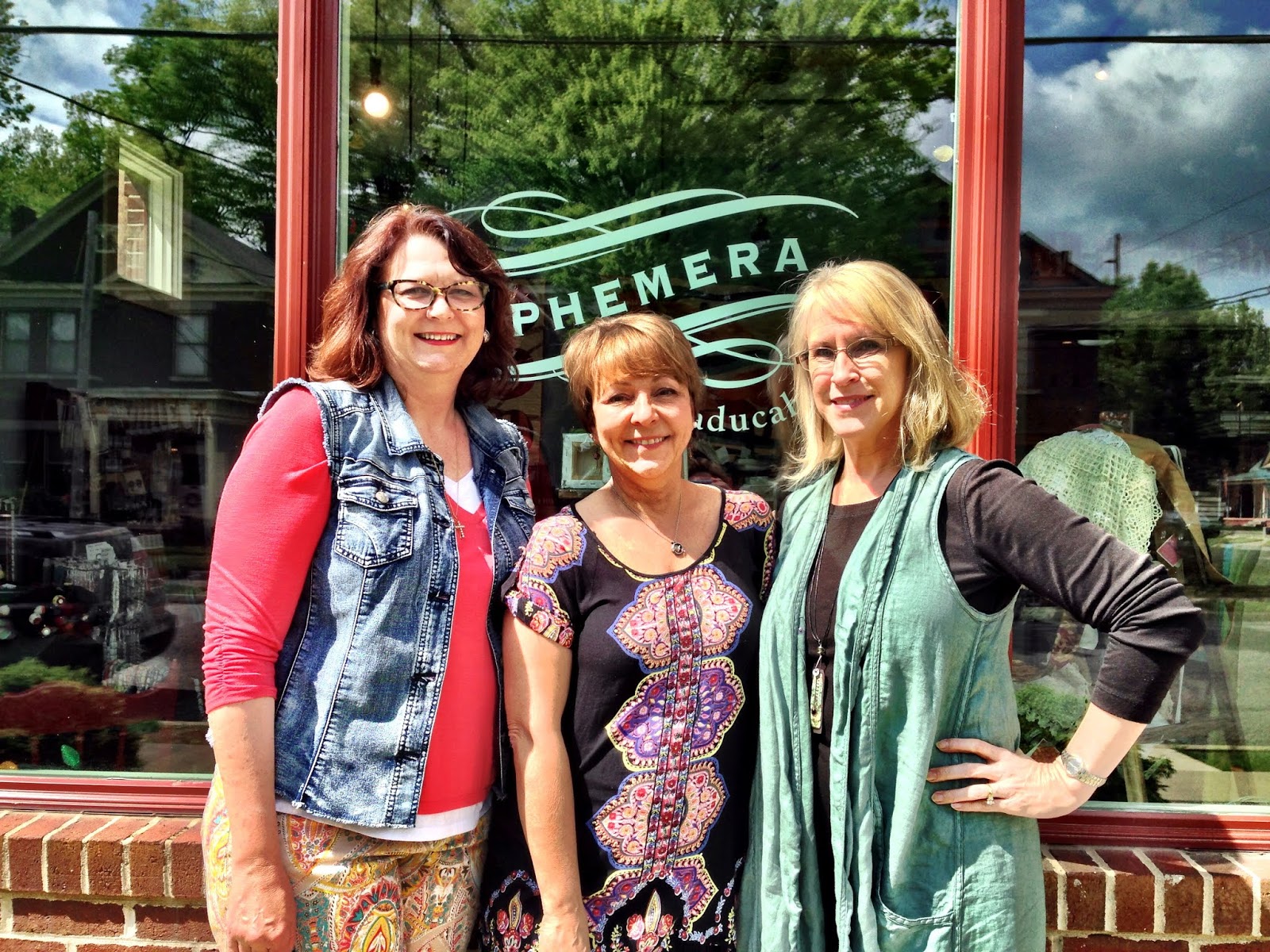
Greetings! I am Kristin Williams, owner of Ephemera Paducah. I’ve hosted over 200 workshops, taught by traveling instructors or me, since opening my business in 2013. 

I’ve said to a lot of people that, since Covid, we’ve all changed a little bit (of course, Captain Obvious). Many of us haven’t been in groups of people in literally a couple of years. In light of that, a refresher on Workshop Etiquette is what I have for you today. Please take it in the spirit in which it is intended - helping to create a great experience in class for everyone! 

As teachers, we get it. 

You are very excited!!!

We really do get it. It’s a special time when an in-person workshop rolls around.

As teachers, we get excited, too!!!!  

And anxious, nervous, and hoping to do our very, very best so that all our students have a great experience in class. 

Excitement sometimes morphs into events or behaviors that disrupt the class, upset the flow of the experience, create stress for teachers and fellow students, or break trust within the group. Some events are beyond everyone’s control but, there are actions you can take to help create the environment we all crave when taking an in-person workshop.  

I posed three (3) questions to a number of popular teachers who are on our mixed media circuit. They all answered within 24 hours. Quotes are in italics; other answers I combined and added my own thoughts and experiences.

What behaviors from students do you appreciate the most when teaching in-person?
What behaviors do you appreciate the least when teaching in-person.
What advice would give someone getting ready to attend their first in-person workshop?

For the most part, answers to questions 1 & 2 mirrored each other at either ends of the spectrum. 

1. Punctuality Makes a Huge Difference.  
Starting late can throw the whole day off!

Showing up on time was identified by numerous respondents, which indicates this is an issue.

We all know stuff happens — traffic, sick kids, alarms, waking up in a strange city. Make sure to have contact information for the venue or someone else in class to call if you are going to be late. Calling or messaging the teacher is not helpful, at all. 

I appreciate those that respect and honor the starting and ending times of a workshop. Those that do not show up way early (which can be disruptive to the flow) and those that do not stay and linger afterward (which can be draining after a long day of teaching). 

2. Read & Follow the Communications About Class

When in doubt or seeking information, go back to the class description, first. Supply lists, class dates & times, address of the venue should all be there. 

Read the Emails. Unless your class is specifically tied to a social media platform, information will come via email. Please read them. Expect that important information about your class may be coming via email near class time. 

Please refrain from using one of a dozen other ways to ask questions about class like in a Facebook post or via Instagram Messenger (unless specified by the venue). Sometimes I spend 15 minutes looking for the question that flashed across my screen. Email, please. 


3. Supplies 
 Pack light for a better workshop experience!
I have literally groaned when I’ve seen Roller Bags come into the Studio when supplies that would fit in a toolbox are all that was required. It creates a space issue, cramps neighbors at tables, and instead of being in the moment and using what is provided, students waste valuable class time digging through stuff for the imagined “perfect” piece of somethingorother. 

Bring the supplies on the list. Don’t overpack, especially if that class takes place at a store where additional supplies are available. 

And, please be respectful of shared supplies. 

Don’t dispense paint you will never use. 
Don’t treat supplies that are shared in a wasteful or destructive manner.
Don’t hog the shared supplies. 

4. Listen, Be Curious & Go With the Flow

You paid for the class and made time to take it, let the teachers take you there. Do it their way and see what happens. Use the supplies they recommend and share. 

Listen with both ears. Take notes. 

I appreciate it when students are receptive and trust me to guide them through the process. The students who can grasp the concept that we are there to learn, and perfection is just not part of that equation are the best. 

I love it when students listen and ask relevant questions. 

I don’t appreciate it when students are on their phones and not listening when I am talking. 

I do not appreciate it when a demo is going on with the teacher instructing and an experienced student interrupts with their own experience unintentionally hijacking the demo.

I appreciate when people are engaged and ask questions but do not appreciate when they monopolize the conversation, try to show they know more than the teacher, or have unrealistic expectations of personal attention from the teacher for any number of reasons. 
Please don't be "A Creeper." 
Make sure not to spill into someone's space
5. Be Responsible for the Energy You Bring into the Space 

There are the basics like not talking during demos, cleaning up your mess, and not encroaching on someone else’s workspace that helps shape the workshop, but there are some less obvious things that can seriously impact the vibe in your workshop.

I do not appreciate it when someone is on their phone throughout the day and then suddenly verbally blasts out some kind of terrible "breaking news story" which can bum out the entire positive creative vibe. 

An individual’s anxiety and fear of not knowing what is coming next can impact the class as well as the students who are so paralyzed by perfectionism that they bring the whole room down with self-deprecating phrases like “oh, this is horrible” or “my work looks like garbage.”

Be kind. Art classes should be safe places. All artists are welcome whether new to the subject matter or advanced. We all need kind words. It’s often simple and kind reinforcement that drives artists to do better and try new things. I really like it when I see people encouraging and uplifting each other no matter the caliber or level of their work. 

I appreciate the students who pay attention, respect, and assist with the ADA accommodations in place for students with disability needs so that they can have an inclusive workshop experience. 

6. Understand this is your Teacher’s & Venue’s Livelihood.

The great ones make teaching look easy but please do not underestimate the time, energy, and financial resources that go into teaching on this circuit. Don't let the buzz of creative energy or the party atmosphere obscure the fact that they are working. 

Ask before taking photos and take them in moderation. Also, give credit where credit is due.

I don’t appreciate it when someone is at their table talking about great deals at Big Box stores while being in a small store. 

I’ve seen students take photos of everything a teacher brings, paging through journals, and it erodes trust wondering where they will end up. 

Every teacher has different ways they recharge for the next day. As an “Extroverted Introvert” my “charm factor” wears off by the end of the day. Please don’t hold it against me if I need to go back to my hotel room instead of a group dinner so that I can be my absolute best in class the next day. 

Many students are genuinely intrigued by how artist-instructors or venue owners have created their businesses. And, most venue owners and artists enjoy sharing their stories. But, not in the middle of teaching or running a class. Make a connection and follow up with a phone appointment if this information is something that will help you find your way. If you are looking for a critique of your portfolio or business plan, consider asking what they would charge for that service and make an appointment for that before assuming it comes with their presence in class. 

90% of the teachers have quit using handouts for class because of sharing after the fact. I have never allowed video in my class for the same reason. Please do not go home and “teach” your friends step-by-step instructions of what you learned in class. 

I’ve posed to a student or two, imagine if you had 20+ people watching you do your job. How much would you appreciate someone you just met sitting in the corner of your office and correcting you as you worked in front of an audience? Would you appreciate it if they second-guessed, out loud, what you were doing? Please let teachers do their job and save any constructive criticism for a private conversation or feedback survey. 


Finally, here are suggestions for first-timers (or those who are venturing back into in-person workshops).


Enjoy the moment. It’s a workshop where you are learning a new skill and not becoming a master in a couple of hours. Realize that the teacher, and possibly some fellow students, have spent years, sometimes decades, to attain their skills. 

Do it even though you are scared. 

Be open to going to the places the instructor brings you to, and be excited because the experience may change you as an artist. 

Relax. Release yourself from the need to have a perfect outcome. Go to classes to experiment and learn. You can take skills home and make something awesome but you may not make amazing art in class. (And that is OK.)

Come as a Kindergartener.

Look around you. You won’t be the only new person. Engage with the other students. 

Show up just are you are. You are already creative enough. As a first-timer, you may be sitting shoulder to should with those who have more wisdom or experience but all are uniquely connecting through creative camaraderie. Enjoy the workshop and give yourself permission to express your own creative voice. 

What I have found is students are most importantly seeking community. Wanting to spend time with like-hearted others to create together. Being in a safe space of welcome and belonging….This is where the experience transforms from perfunctory to a powerful gathering for all. 

Thank you for taking this in the spirit in which it was intended -- A gentle reminder of the role you can play in curating an incredible workshop experience for our mixed media community. If I've left something out or something really resonated with you, please comment, below. 

Wednesday, March 30, 2022

Mary Beth Shaw's VLOG: March 2022

Join Mary Beth in Amsterdam and Paris!
Click here for more information and registration!
We hope you enjoyed this episode of Mary Beth's VLOG!

Stay tuned!
Mary Beth Shaw will be back again next month with another new VLOG post!

Monday, November 19, 2018

Advice for Attending An Art Workshop or Retreat


I get it. It's daunting.

A mountain of resources — money for registration fees, supplies and travel, scheduling time away from work and family, expending vacation days, and balancing “me time,” with what’s best for everyone else in your life — go into getting away for a weekend to learn and create.

It takes a lot! And, I so appreciate what it takes for someone to even get to a workshop.

There's anxiety about travel, having the right stuff, being "good enough" to take a workshop, treating oneself, and "will the people there be nice?"

There’s a lot of pressure to make it a perfect experience, make perfect art while you’re there, and walk away with perfect memories… Perfect! except for that “perfection” trap!

Allison Revetta, long-time workshop attendee, mixed media lover & friend, says it best: “
"My advice to a first-time workshop attendee would be to let go of expectations and just relax and let
What would you have a Billboard flash during your workshops?
it happen. It is a learning experience and you probably won’t make a masterpiece in class. I look at workshops as information being imputed in to be spewed out in the future (recognizable as that workshop or not). Creativity is a muscle that needs attention and workouts (workshops). There is something about the creative energy in groups that you can’t get working online or alone. It’s the experience of being with like-minded people, the process not the results.”

As the owner of Ephemera Paducah, an art & craft workshop space, I have the privilege of hosting hundreds of “Everyday Artists” in my Studio each year. I’ve wanted to write an article or blog post for some time about how to get the very most out of your workshop experience.

It kills me when I see students struggle in workshops whether it’s digging through way too many supplies to find the “perfect” piece of paper or letting comparison rob them of the joy of creating, not acknowledging that everyone is showing up with different experiences, expertise, and years of learning. Dealing with all that emotional or physical stuff distracts from the reasons they are there. I’m hoping this piece can help someone get more out of a workshop they’ve looked forward to, planned for financially, and set high expectations on!

Below is a list of ways to help make your workshop experience as wonderful as possible. And, I  asked some trusted advisors of experienced workshop attendees and Artist-instructors for their thoughts. I hope this gives you the confidence to take the plunge and enjoy creating & learning in a room full of people as I think there’s nothing like it in the world.

Suggestions for a Great Workshop Experience


Connect 

The great news is you’ve already got one in thing in common with your fellow workshop attendees! Art! If you don’t have an “Art Buddy” to travel with, go anyway knowing you are going to find “your people” at the workshop. If you are on the fence about traveling alone, take the dive. When someone says, “who wants to go to dinner?" say, "YES. I do!” If there’s a Facebook group or pre-email from the venue, put yourself out there and start getting to know your fellow attendees.

Veteran workshop attendee, Lisa Visel, says, “What do I think of when I think 'workshop?' Excitement to learn and make something in a group setting. Meeting people, old friends and new, to have fun with and laugh with. Nourishing my creative soul with something (probably) new.”

Scarlet Fields makes the same point based on her experiences attending workshops, “Don’t be nervous; these are your people!  Allow yourself to be a student. Give up perfection.  Work hard, play hard.  Ask questions. Introduce yourself to someone new every day-really introduce yourself. Be open to all of the delicious energy.”


Supplies

Denise Hug, a former shop owner and lover of workshops says, “you don’t have to bring the kitchen sink.” 
Regardless, bring a small journal

I admit it. I’m not a minimalist. And, I used to do it. I remember mailing two (2) 50-pound boxes of supplies to a retreat I was attending in Las Vegas many moons ago. Did I touch 95% of that stuff? Oh, heck no! Did it weigh down my experience as I man-handled it to the room? Create stress about how to get it back home? Still consume my psyche with, “do I have the right stuff??” Oh, heck yes. It. sucked.

Bring the items on posted supply list (in minimal quantities) and your Basic Kit, and that’s all you need. Seriously. That’s all you need. And, know that people who attend workshops and retreats are nice. They share. I truly believe from personal experience that one learns more the less she has to dig through “stuff.”

Basic tool kit fits in here. 

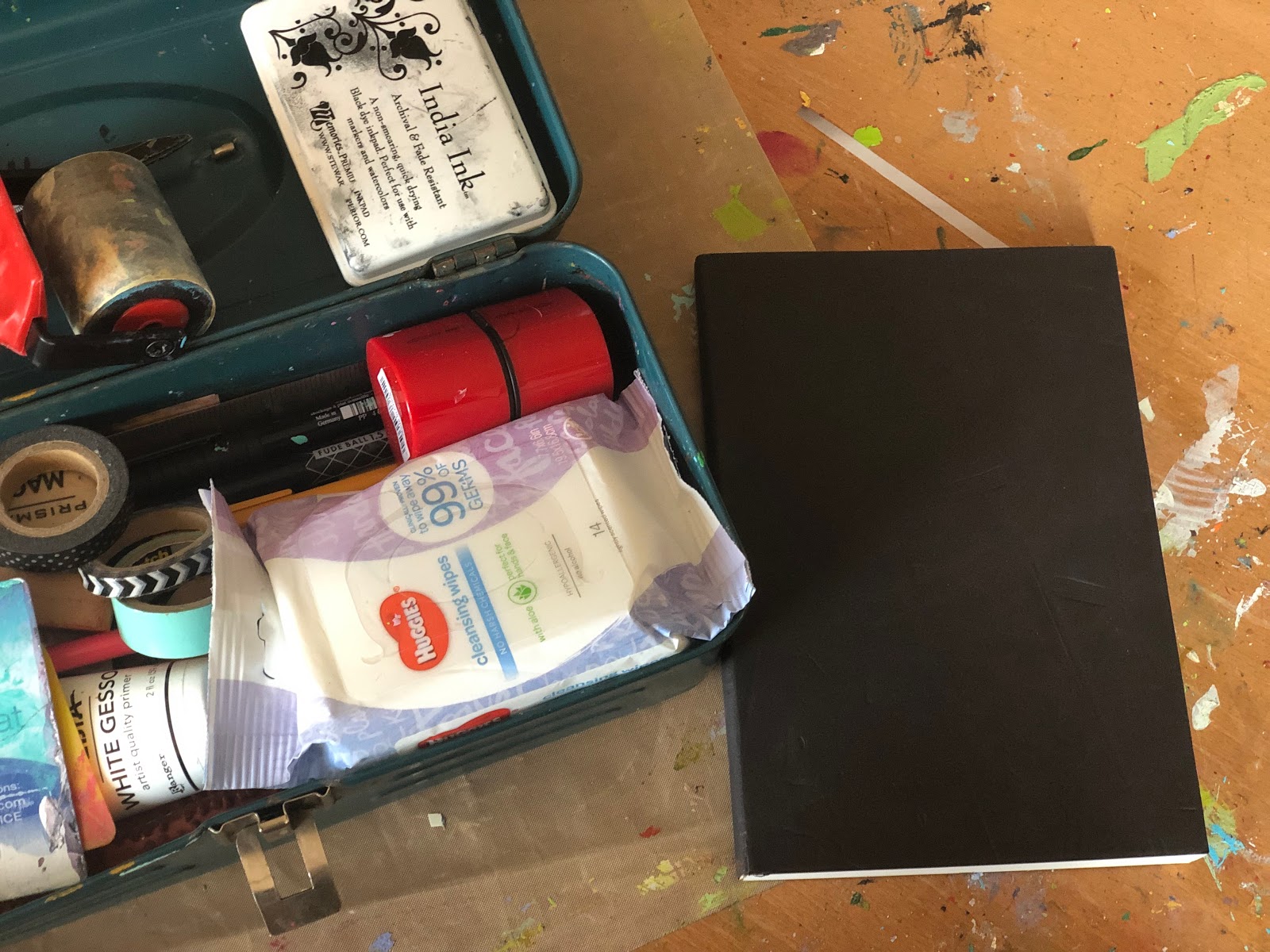
Here’s my basic supply kit:

craft mat
small journal (regardless of the class great for notes or swiping extra paint in)
favorite black & white pens
black Stabilo pencil
regular pencil
eraser
small ruler
white gesso
2-3 of your favorite washi tapes
matte or gel medium
India Ink stamp pad
a few stamps
6-8 paintbrushes
sponge
pouncer
small empty spray bottle
brayer
old hotel key card
yellow scraper
bone folder
palette knife
scissors
glue stick
a small pack of baby wipes
and of course stencils (I travel with the 6 x 6 or smaller sized ones)

Yours may be different. These are the items I know I’ll grab in any mixed media workshop.

Comfort 

Anticipate what you might need to be physically comfortable. I can tell you once you get more than 3-4 people in a room, it’s impossible to make everyone happy with the temperature. You know whether you run hot or cold, or, if you’re like me, one minute hot and the other cold. Don’t risk being miserable due to room temperature or other accommodations where you will be sitting for 3 days. Dress in layers and throw in that sweater! Bring a pillow for your seat if a folding chair makes you sad.

If you have a mobility challenge or physical need, please contact the shop or venue ahead of time to understand what accommodations can be made. We want you happy and comfortable and will bend over backward if we know what’s needed.

Headspace 

Maybe the hardest thing NOT pack (but try, try, try) is your inner critic. Perfection is not reality.
What would you have a Billboard flash during your workshops?

Glenda Miles advises: “Honor the “pre-retreat” You; seeker of self-care and creative escapades and carrier of responsibilities, worries, and expectations. Welcome “post-retreat: You; proud accomplisher of goals, friend maker and newly expanded, nourished and connected artisan.”

“People are at different levels of experience so don’t compare your work with someone else’s because you may be at the beginning and they may be further along the learning curve.  Perfection is the enemy of creation sometimes.” Janis Graham, workshop attendee.

I think the worst saboteur of enjoyment is the comparison to others and feeling unworthy in a workshop. Many of my advisors noted it in some way or another with their answers.

Gwen Lafleur: “A few years ago I took a workshop with a teacher whose style was very different from mine and had a huge epiphany... once I learned to use the ideas and techniques with my own style rather than trying to emulate the instructor, everything became even more fun and I now take away so much more from the workshops I attend.”

Andrea Chebeleu, “‘Comparison is the thief of JOY’ (quote by T. Roosevelt)  Don't allow your joy to be stolen by comparing your work, your supplies, your anything to your neighbors.  Enjoy the process and  try to be present and soak it up.”
Mary Beth Shaw as a workshop attendee (with Otis)


Joanne Sharpe: “Baby steps. If this were your first piano lesson, you certainly wouldn’t be playing a Mozart concerto!”

Peg Riley gives this advice: “When a fellow student is struggling or feeling like his/her work is ‘beneath’ everyone else’s, that’s the time he/she needs to pause and take a walk around and look at other work.  I'd suggest they talk to the instructor about different ways to achieve their goal.”

Go into the workshop giving yourself permission to learn, to make mistakes, and know that the experience is enriching you. Don’t grade it on your ability to match your own unrealistic expectations.

Scarlet Fields says, “My heart aches when I see a student get caught up in the creative decision-making process, so caught up that they can’t make a decision at all.  I want to say close your eyes, take three deep cleansing breaths, clear your mind, open your eyes and choose the first thing you see.  This isn’t your last and only creative project, it is the one you are exploring now.  Go down the rabbit hole and be Alice.” I love that. Be Alice.

Jenny Doh has a blog post that is profound about being responsible for the energy you bring into a workshop. Or, put this quote on your supply list:

“Take responsibility for the energy you bring.” ― Jill Bolte Taylor 


Interact 

You’ve got at least one expert in the room. Ask questions and get to know the teacher. Learn from your classmates, as well.

Carolyn Dube: “Ask questions and talk!  Ask lots of questions- you’ve got that instructor right there and that is a big part of an in-person workshop and talk with your fellow classmates. Get to know them and their journeys.  Such diverse paths lead people to art!”

Pam Carriker: “Have fun. Get to know other creative people and learn from them as well as the instructor. It can be very inspiring seeing how everyone interprets the techniques. Don’t be afraid to ask questions! What is old news to someone else may be brand new to you. It was brand new to all of us at one point or another.”

Physical Space

I jokingly (kind of) talk about traveling to workshops with a high school friend who I'll call, "a creeper." We'd be working away at the same table when I'd look up and see that she was taking up 7/8s of the space while I was working in mere inches.

Don't be a creeper. Keep an eye on your stuff so that no one trips over it. Be attuned to your personal space and surroundings and the people at your table will appreciate it so much. 

The same deal goes for showing up on time but please, not too early. Understand that teachers need those zen-filled moments before the workshop opens to prepare for you -- mentally, physically and emotionally.

Valerie McCoy from Memphis summed up a lot of good advice in her answer: “Read the supply list and study the instructor's work prior to course.  Don't bring your entire craft room to a class. Be on time. If you disagree with an instructor's response, carry on later on the topic during a break or something.  Support the local shop owner. If you know an item is less elsewhere.. don't make a big announcement.. just keep in mind it is important to support small businesses.”

Stencils

What would a StencilGirl Column be without mentioning Stencils??? I asked my trusted advisors what their favorite Stencils are to bring to workshops. Here’s the lowdown!

Cathy Nichols: I really enjoy using my sun and moon stencil because it adds just that extra pop of symbolism to oracle cards!

Gwen Lafleur: That depends on the workshop, but a current favorite generic stencil that I use in most of mine would be the Collage Textures and Patterns, Circles stencil.

Glenda: All of Pam Carriker’s Halo Stencils —Faithful, Radiant, Creative and Beautiful all representing a sacred circle beckoning and welcoming us into a reclaimed ancestor art story.

Cathy Costelle: Just one, next to impossible?!?! I like to use stencils that help create interesting backgrounds and textures and that will depend on the class project. One of my favs is Seth Apter’s Numbers stencil and Timeless stencil.

Lisa Visel - *all of them? Lol. I like to bring a variety of sizes and designs because I never know what I’m going to want. Mainly my favorites are small designs to use as texture.

Debi Adams - Stencilgirl stencil...hmm. That is REALLY hard. I use Seth's and Mary Beth's a lot, but I never leave home without Rae Missigman's Repetition stencil. <3

Mary Beth Shaw: My Grid set

Allison Revetta - I never leave home without my Rae Missingmen small stencils. The repeating dots is my go to plus arrows, triangles, flowers... all Rae, all the time

Carolyn Dube - Wall of Words - I love adding text and it is so versatile for doing a background, adding a title, or just a little random word here or there.

Pam Cariker - One of my favorite stencils continues to be the color wheels. You can learn so much from playing with color and they are such a great visual image.

Valerie McCoy - Carolyn Dube's Wonky Eyes stencil

Julie Snidle - My favorite SG stencil is the Scribble Scratch Handwriting stencil.

Janis Graham - That changes with what I’m doing, but for words,Words to Live By”.  For making backgrounds it is hard to beat the 9x12” ATC stencil #2.  It gives so many different patterns on one stencil.  My personal current favorite stencils are the spirit wind masks.
I like Carolyn Dube’s “

Scarlet Fields - I have become very fond of the back groundish stencils and since Mary Beth told me I could cut them up, I use them more.

Peg Riley - I don’t know the name of it, but it’s SC-01-2017…has many design elements on it…

Thank you to all my trusted advisors for their great advice. And THANK YOU to the teachers and students who travel to Ephemera Paducah.

I hope this gives you some ideas and the push you to put “take an art workshop” on your 2019 New Year’s Resolutions List!

oxoxo

Kristin Williams