Showing posts with label Jane Monteith. Show all posts

Monday, October 2, 2023

Transformation: Inspired by Jay DeFeo

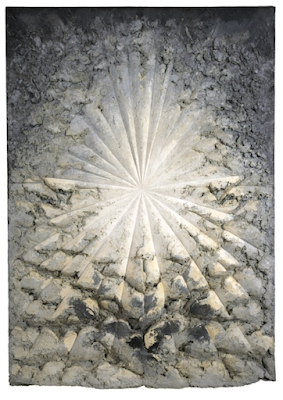
Jay DeFeo, The Rose, 1958-1966
                                                                                                                  

      The study of masterpieces necessarily involves some consensus about who the masters are or were.  In my first year of college in the late 70s, the year-long survey course in art history exposed me to perhaps three female artists - Mary Cassatt, Frida Kahlo, and Georgia O’Keefe.  The museums I visited, and the art history books I studied, displayed a nearly unbroken line of male artists stretching back through time.  It pains me now to realize how seldom I questioned that dominance.
    Two unrelated events this summer turned me around.  The first was a visit to the Whitney Museum of American Art in NYC on day trip in July to meet some good friends for lunch.  We’d hoped to walk the High Line after lunch but it was so infernally hot we couldn’t bear the thought of it - so instead we went to the Whitney, which is at the bottom of the High Line, and which would be a good starting point if it cooled off enough later to take a stroll.  While in the museum we were mostly occupied with chatting and
catching up, but at one point I found myself in front of a massive work that was new to me.  This was The Rose, by Jay DeFeo, a monumental painting with incredible dimensionality and texture.  Arresting, to say the least.
    The second event was attending a lecture/book talk at the Hyde Collection in Glens Falls, New York about the book Ninth Street Women, by Mary Gabriel.  This prodigious tome chronicles the work and experiences of Lee Krasner, Elaine de Kooning, Grace Hartigan,
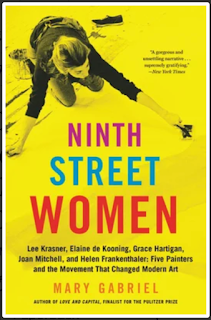

Joan Mitchell, and Helen Frankenthaler - women who were in at the dawn of the New York abstract expressionist movement after WWII.  They were there along with the male artists whose voices and visions always insisted on the lion’s share of attention, (deserved or not), sharing gallery space with Jackson Pollock, William de Kooning, Robert Rauschenberg, Robert Motherwell, and other rising stars of the New York scene.   It wasn’t until I got home from the book talk that these two events converged to bring me to my Master Piece for this column.
    I was chagrined and angry about the gap in my art education that Ninth Street Women illuminated for me.  Down the Google rabbit hole I went, learning more and more about the female artists of the post-war era who contributed so much to the world of abstract art, and who had to fight so hard for recognition.   Across the country from New York, the vibrant Beat scene of San Francisco brought together poets, painters, and musicians for an exchange of exciting ideas and innovations.  Jay DeFeo was one of those vibrant creatives.
    Her work The Rose, which I encountered that day at the Whitney, took her seven years to complete - it is an accretion of paint and mica, layer upon layer, that she carved into, making it, in her words, “a marriage between painting and sculpture.”  At 11 feet tall and almost two thousand pounds, it was so large that one exterior wall of her apartment had to be opened up in order to extract it.  The Rose was first exhibited in 1969 at the San Francisco Art Institute, and eventually acquired by the Whitney in 1995.  The surface is highly textured, both dark and glittery.  During the seven years she labored on this painting, she developed a habit of sticking her paintbrush in her mouth, gripping it with her teeth while she used her hands to manipulate the surface.  As a consequence of repeatedly chewing down on the paint-laden brush, she developed gum disease and even lost some of her teeth. 
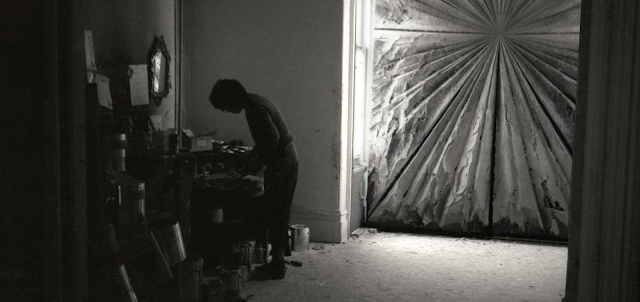
Jay DeFeo working in her San Francisco apartment, with The Rose in the background


    Which brings us to her painting, Crescent Bridge I.  These pale, rock-like forms, smooth and polished, seem to rise out of the white of the paper, with dark shadows or reflections beneath them.  It seems both abstract and realistic, and also deeply mysterious.  Where does it lead? Why does it stop?  What kind of a bridge is it? 
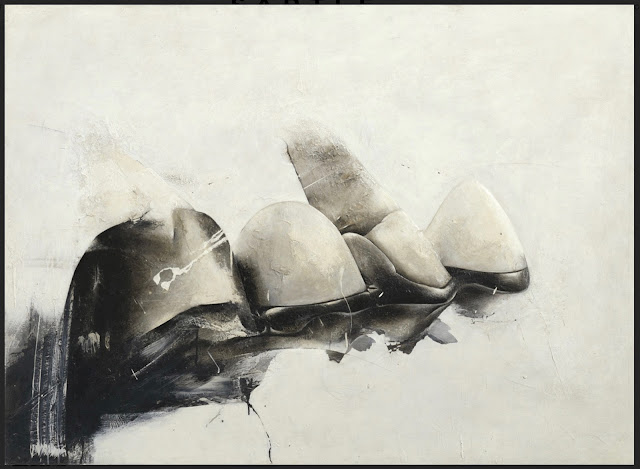
Jay DeFeo, Crescent Bridge I, 1970-1972, Whitney Museum of American Art

Well, as it turns out, it is her dental bridge, which replaced the teeth she lost working on The Rose.  Crescent Bridge II makes it more explicit.  Now we can see they are teeth.   Jay DeFeo also made extensive use of photography in her later work, making dramatic photos of her own paintings as well as objects in her studio that stood alone as separate works. 
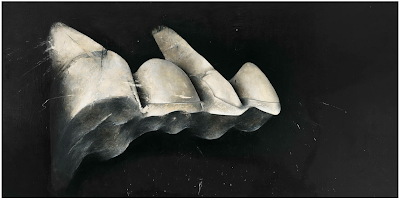
Jay DeFeo, Crescent Bridge II, 1970-1972, Whitney Museum of American Art


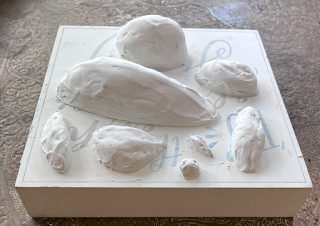
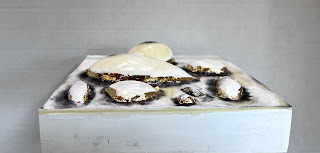
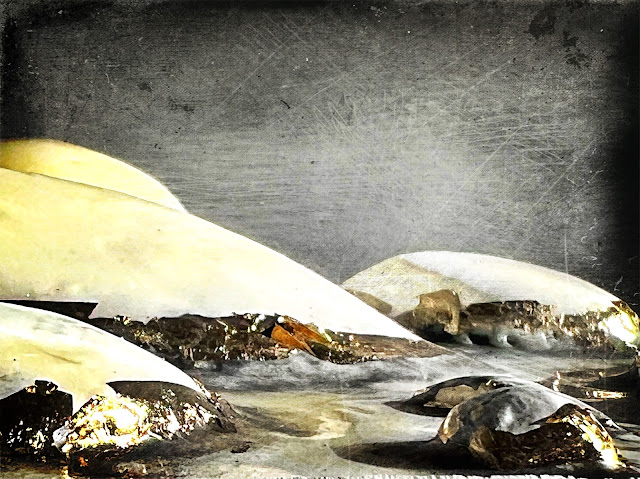
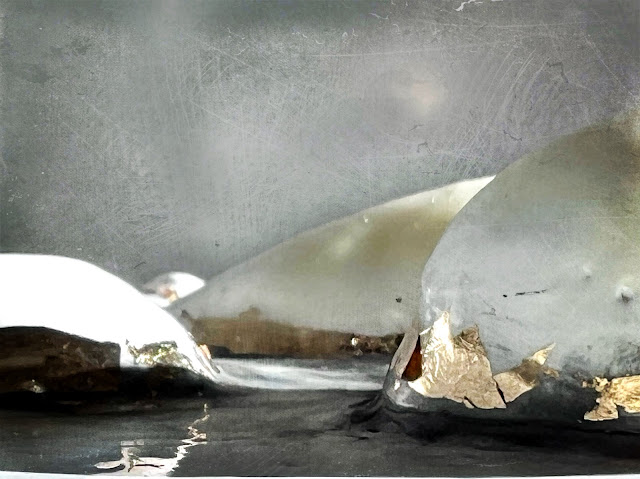
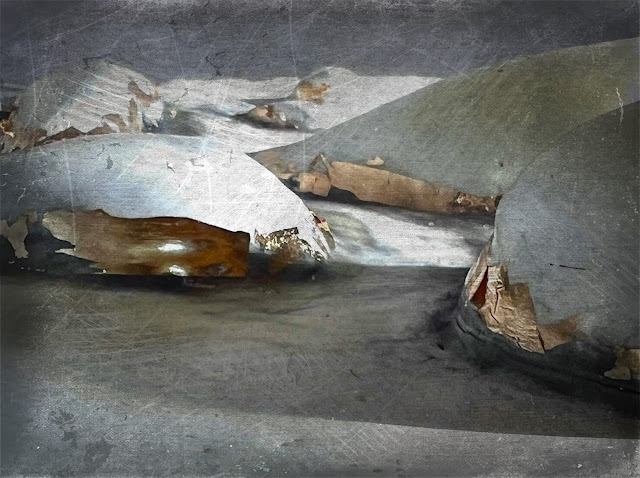
    As the project for this column I decided to pay tribute to both The Rose, and Crescent Bridge I, by creating a photo series of a dimensional work I call Archipelago.  I used just one stencil for this - Stone Stack, by Jane Monteith L929.  This is a 9x12 stencil but I decided to use a 6x6 square cradled panel (a repurposed wall decor piece from the craft store).  I suspected this project could end up being heavy, so I needed a sturdy substrate.  I had already given the panel one coat of gesso; now I needed to lay out the stencil to fit, and tape over the shapes that I didn’t want to use as part of the composition.  This stencil comes still attached to its mylar matrix so you can carefully cut it loose and use the outline as a mask.  I needed to keep it all intact, so that I could build volume inside the openings and keep the rest of the surface clean.  To build up the “islands” of my archipelago I used joint compound in multiple layers, removing the stencil each time to let the compound cure.  After the islands were as big as I wanted them to be, and had dried, I very carefully sanded them smooth to mimic the smooth teeth of Crescent Bridge I, and then applied several coats of gesso thinned with water to give it all a smooth, enamel appearance.  I used gesso rather than paint, so there would be enough tooth (no pun intended) to hold wax, graphite, and gold leaf.  I’ve used encaustic before for a project in this Master Pieces series and I knew encaustic medium would give me exactly the smoothness and ivory color I wanted.
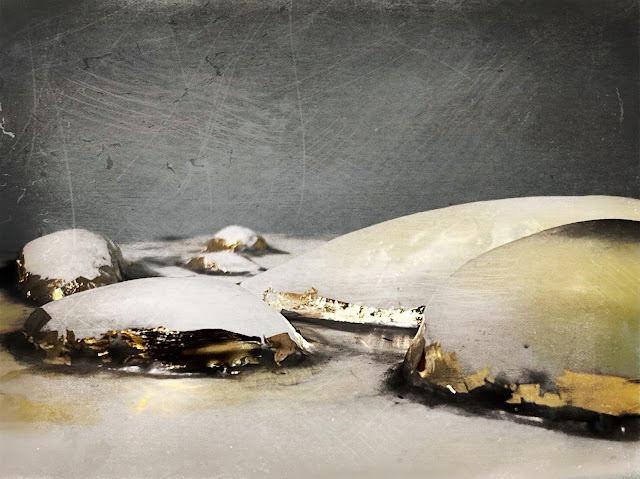
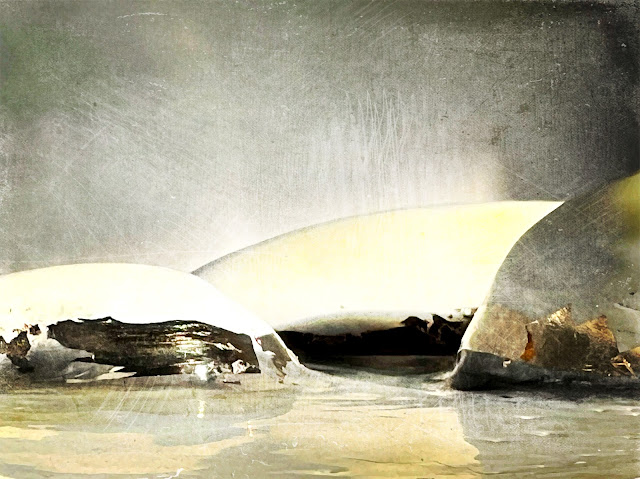
    As usual, the process of painting with melted wax presented its own challenges, especially as melting wax wants to flow downward as it is reheated.  The mounds of gessoed joint compound slowly began to assume the abstract organic forms I was going for. I dusted powdered graphite around the bottom of each island, and then added a patchy strip of gold leaf just above the “water line.”  I then photographed the work from a few different angles to find the ones I liked best, and treated them to some digital editing with the Distressed_FX Pro app.  
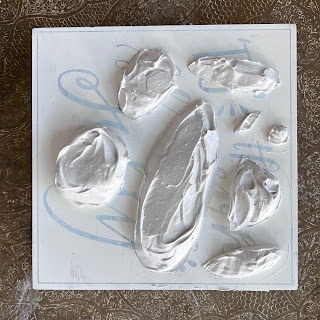
process step 1

process step 2 or 3...

another view of the Archipelago before sanding

After sanding and several coats of thinned gesso

the archipelago shown with wax, graphite, and gold leaf

Archipelago I

Archipelago II

Archipelago III

Archipelago IV

Archipelago V


    This project took quite a long time.  There was considerable amount of drying time for the thick mounds of joint compound. I didn’t try to speed up the process with a heat gun, because I was worried it might lead to cracking.  Each coat of watered-down gesso took half a day to cure completely, and of course applying multiple layers of wax requires heating up and cooling off periods (as well as periods of walking away in a fit of anxious frustration).  Painting with powdered graphite and applying gold leaf were finicky and tense - it’s hard to undo when working on wax!  And finally, the photographing and digital editing is a process that can go on and on, endlessly trying out different angles, lighting, formats, filters, and layering effects.  With each stage of the long process, the piece underwent transformations of shape, size, texture, hue, tone, and weight, from a two dimensional plane to a three dimensional sculpture back to two-dimensional photos in electronic form.  The model itself is a very physical thing, inviting touch, whereas the digital image is virtual and untouchable.  The effects of time and transformation are the lessons I learned from Jay DeFeo while working on this, and they are lessons I am grateful for.
    
    
    Learn more about Jay DeFeo at The Jay DeFeo Foundation 


Jane Monteith Stone Stack L929


Thursday, August 31, 2023

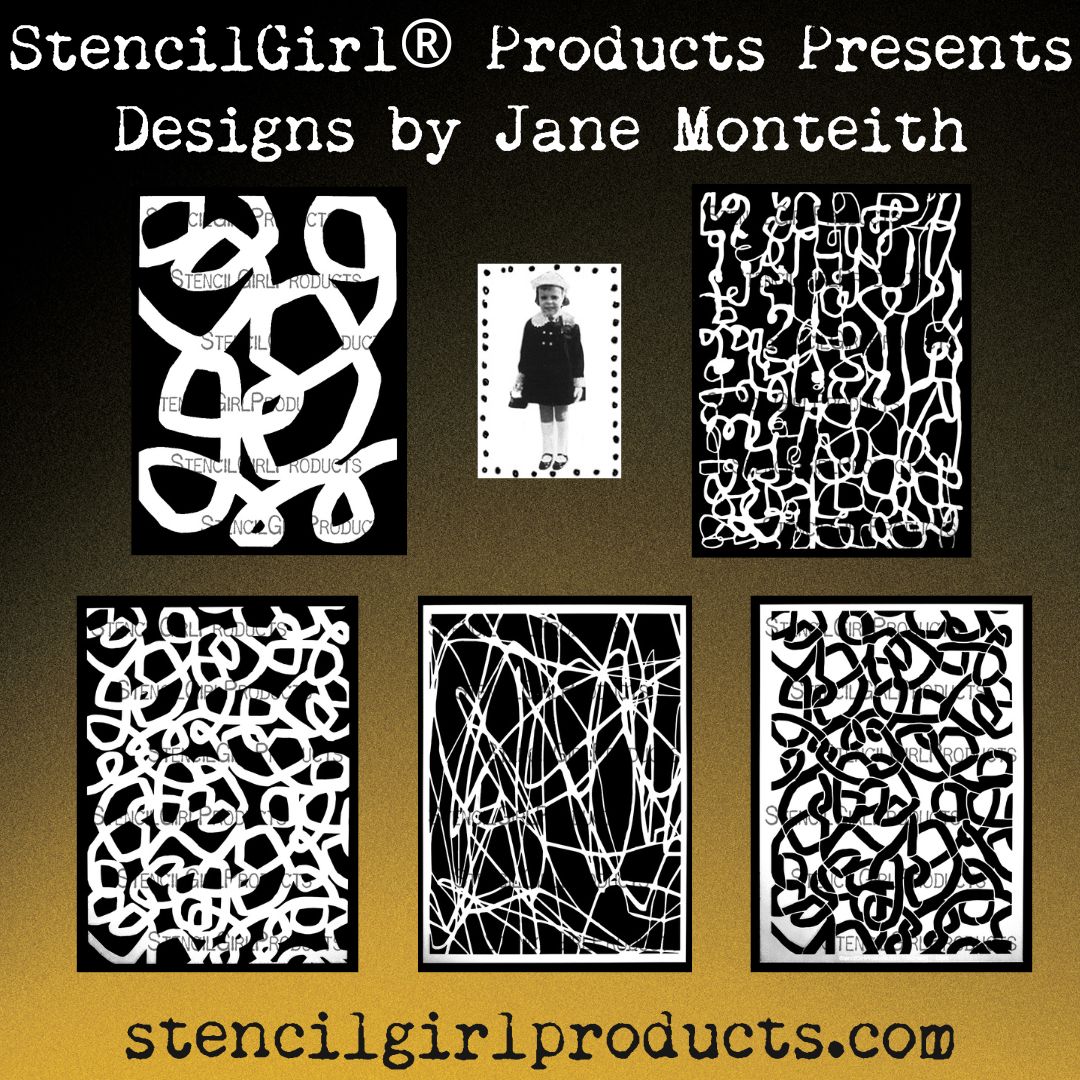
Announcing New Designs from Jane Monteith

Jane Monteith has five new fabulous designs releasing today, so without further adeio...


Get your grunge on with Graffiti. Inspired by spray paint and street art. This big and bold stencil designed by Jane Monteith will add a cool edginess to your artwork. Great for layering and masking over pops of vibrant colors that won't go unnoticed. 


Designed by Jane Monteith, Tripwire is a journey of random intuitive marks inspired by quill and ink. This stencil is a combination of larger lines flowing into thin wire like marks, making this stencil unique in all sections. Give your art lots of interest with Tripwire. 
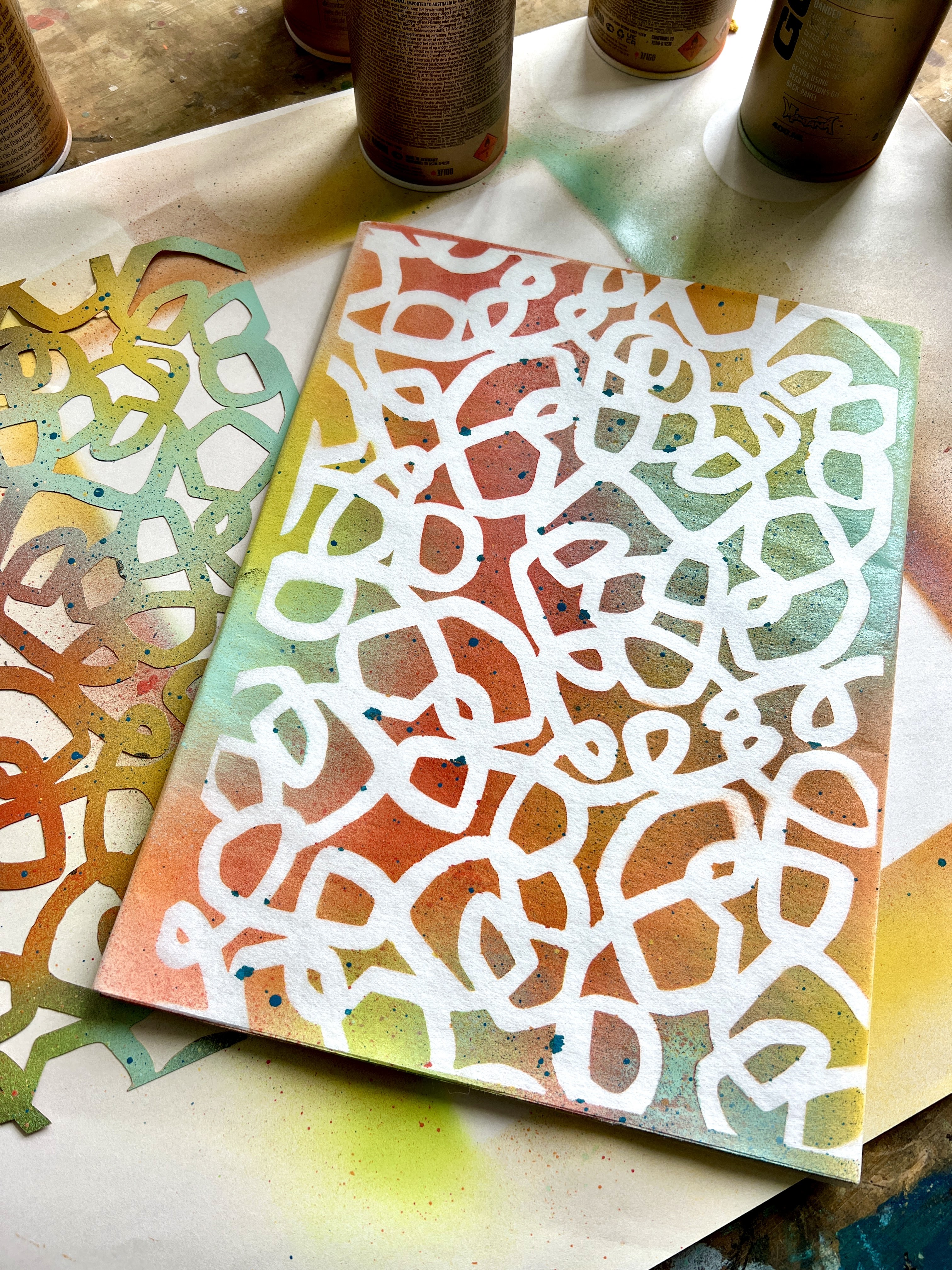


Just like scribble on paper, the Scribbley stencil by Jane Monteith creates the impression of pen marks in your artwork. Lots of quick long thin repeated lines, just like chicken scratch on a notepad.


A mini version of Graffiti, this smaller style stencil called Graffiti 2 has more ribbon like curls and twists. There is also an accompanying mask (see below). Have fun and mix it up with both versions in your artwork!


Jane's stencils are available now at stencilgirlproducts.com


Tuesday, June 27, 2023

How to make your Own Decoupage Papers with Jane Bellante

Hello everyone!  

Jane Bellante here and I have to tell you, I absolutely LOVE making my own papers with StencilGirl Stencils! I'm mildly addicted (well, maybe more than mildly hee hee), and I use them for everything- collage, backgrounds, home decor, and furniture!

For this tutorial, I found a super cool large vintage toolbox at a local flea market.  I ordered some wood legs from Amazon so I could make this toolbox into a table.  The legs have a Mid Century Modern feel to them, so I decided I wanted to use the Kinsugi stencil by Jane Monteith.  It has clean lines, but also a more updated, modern look which I just can't get enough of.  

For the tool box, I used Paint Pixie Undercover Primer to cover up all of the old paint and give this homemade paper a good chance of adhering.  

Then I grabbed my Dina Wakely Gloss Sprays in Gilt and Syrup and got started spraying my large tissues.

You can watch the full tutorial on how I made my papers right here:


This process is so easy and so much fun! Just make sure your area is protected because sprays can be very messy.

I took my tissue and decoupaged it onto my toolbox using soft gel, then I did two coats of Paint Pixie Forcefield to protect my paper from getting damaged. I'm dying over the result!


Thank you so much for watching, I hope I inspired you to use your favorite StencilGirl Stencils to create your own papers and tissues for decoupaging anything and everything!

You can find the Kinsugi stencil right here, and you can find on all social media platforms at @janebellanteart, and on my website at www.janebellanteart.com.

Please let us know if you enjoyed this tutorial by leaving a comment below!

xo, 

Jane


Friday, April 21, 2023

Haiku ATC Booklet to Add On - by Claudia Neubacher


Servus, hi and thanks so much for stopping by today! 


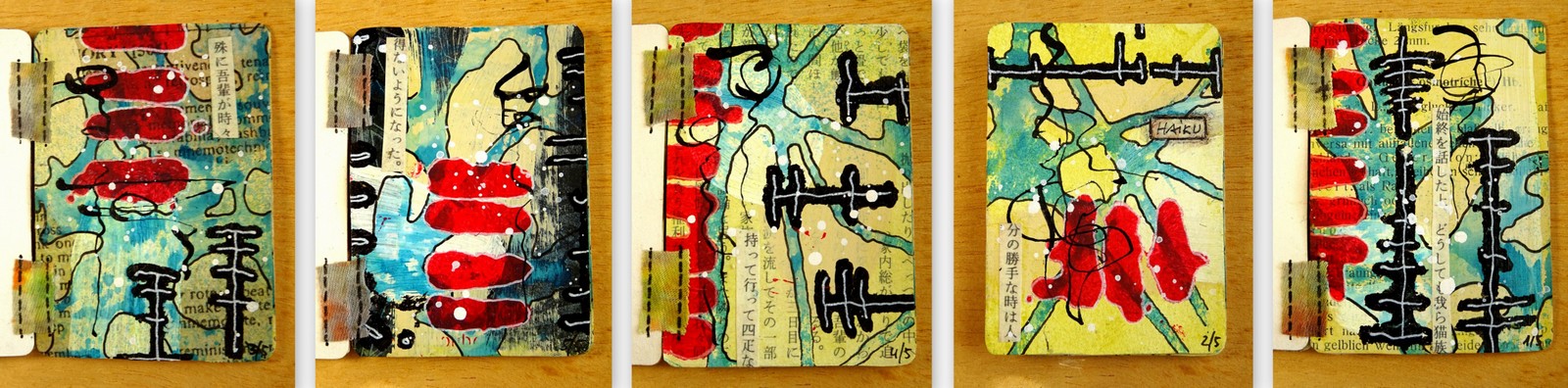
I am sharing a small (you could almost call it tiny) project with you today that I have created using large stencils only. And I did so on purpose. Why? I recently found I have been narrowing down myself in my creative thinking as I have for a long time considered large stencils only going with large format projects. Which makes sense when you are using stencils that have a rather specific design like a scenery or portrait for a example. But when it comes to abstract stencil designs only using part of the stencil is not only an option but also a great way to add some creative randomness to your project designs. And they are great fun to use for mark making. 
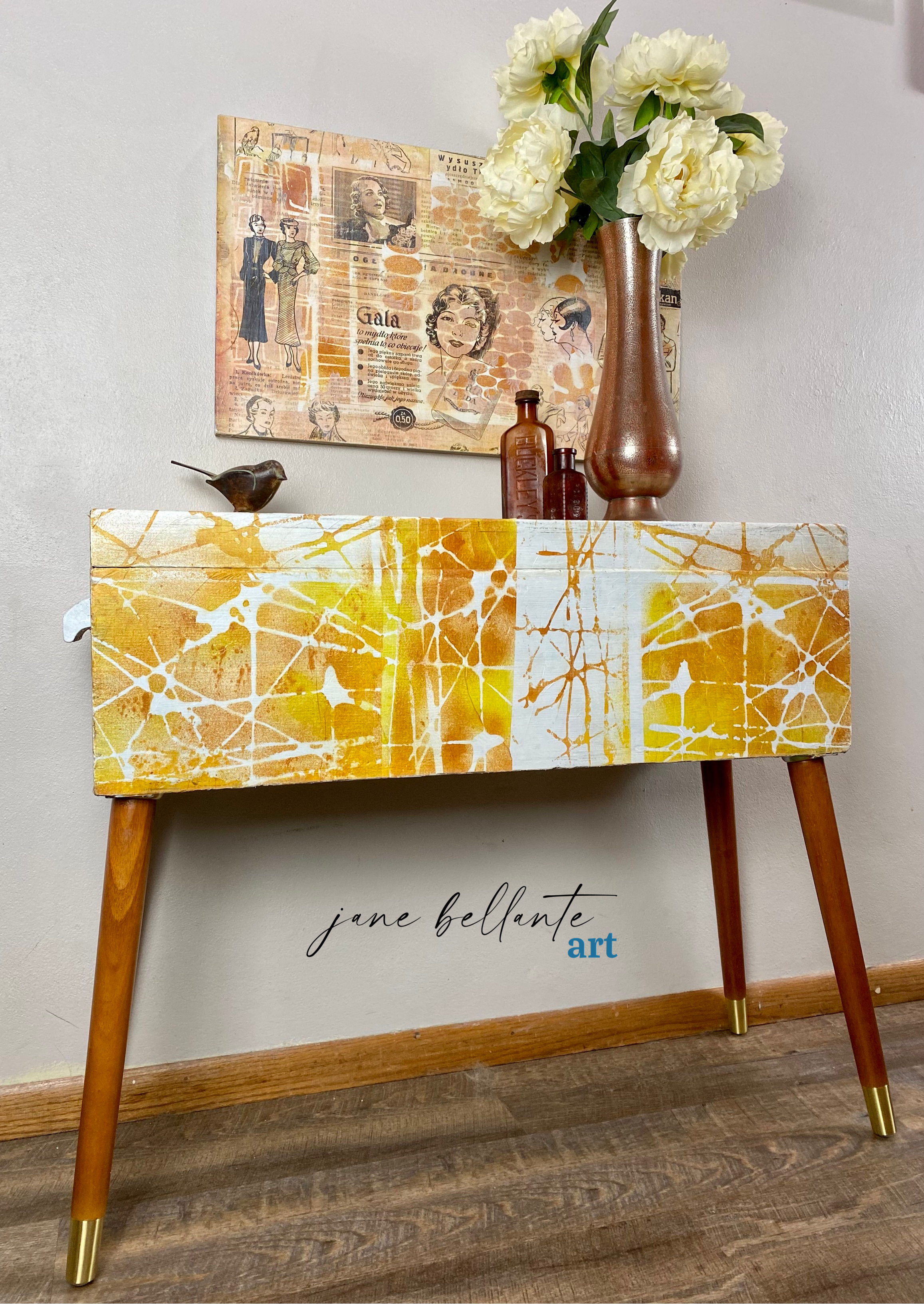

So I decided to take that idea to the top and pick the smallest format I know - ATC size! 
The beautiful large format StencilGirl® stencils I picked to create a set of five abstract ATCs were these: 


by
Dave Daniels


by
Seth Apter


by 
Seth Apter

and


by
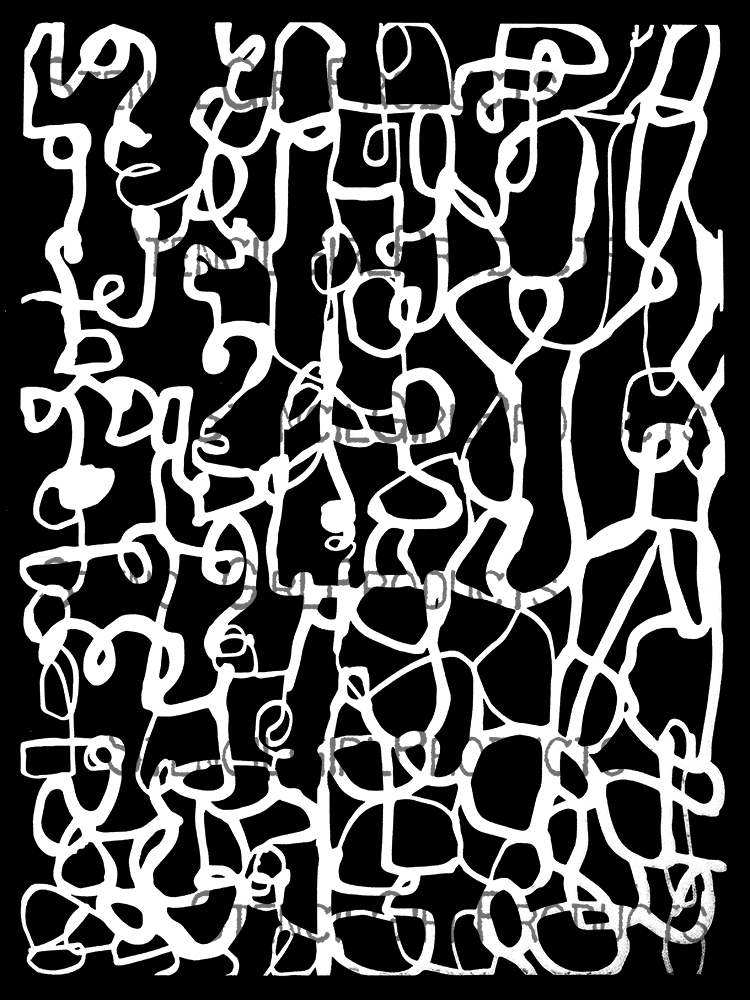
Jane Monteith


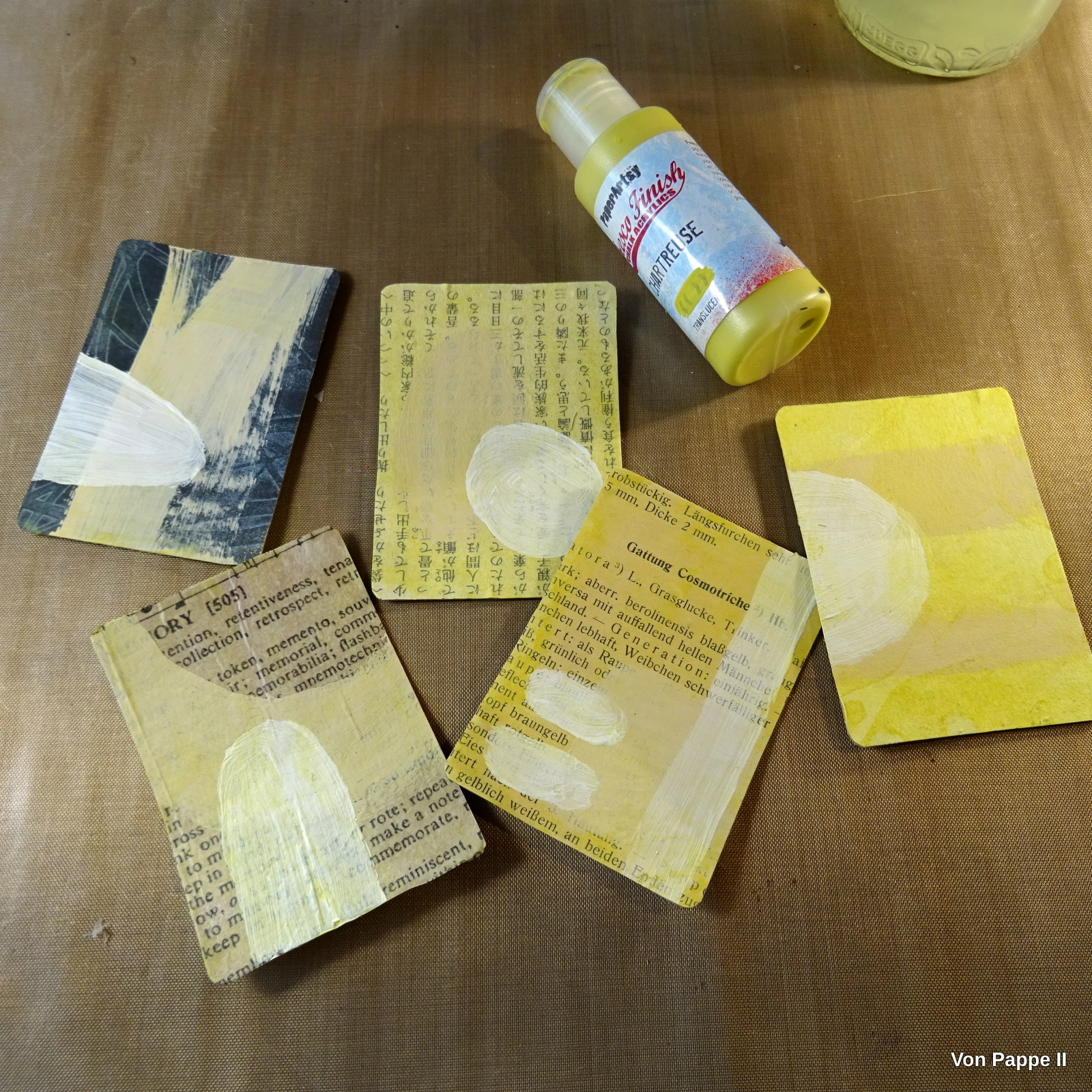
I didn't plan any of the designs for my ATC set. Actually I tried to kind of surprise myself, so I decided to let the results from each step lead the way to the next choice of design, colour or medium. To prepare the ATC backgrounds I picked some old book pages and papers from my stash (the black ATC in the middle shows an old gel plate print done with another StencilGirl® stencil (for this project here). I glued these to the die cut ATCs using DecoArt matte Decou-Page and a soft wide brush. 


Then I "primed" the ATCs by adding random brushstrokes using DecoArt "beige" Chalky Gesso and DecoArt premium White Gesso. I didn't overthink this step - I just made sure I had both colours on each ATC and that these overlapped in some spots. 


Once that had dried I added a layer of translucent PaperArtsy Fresco Finish Chalk Acrylic "Chartreuse" on top. Before the paint dried I wiped most of it back using a baby wipe. This way the ATCs got kind of "tinted" and all the detail underneath still showed through. 


I wanted my first stencil-layer to contrast the cold yellow-ish tint, so I picked the "Teal High Heel" Chalkboard Glimmer Mist from Tattered Angels for the next step.


On my craft mat I misted the stencil with the spray paint and then pressed the ATCs face down into spots I thought would create a great pattern. This way I got some really cool random designs! 


I repeated that step with a different stencil. The picture below also shows that I always try to use up all the paint that I have used. In this case I also pulled a print using a sheet of printer paper (the one to the right). The paper to the left is the one I had in my splatter box when misting the stencil. 


It's always nice to have some self made papers for future projects, isn't it? 

Time to add some focal elements! I used DecoArt media Carbon Black acrylic paint and a small stipple brush to only use single elements from Seth Apter's stencil. I thought they looked a bit like calligraphic elements - which was a perfect design to use for my little Haiku ATC Booklet. 


In some spots I only used half of an element to create an interesting border...


Finally I needed a colour that would really pop and contrast the cool blue and yellow - so I went for a bright Cadmium Red (I grabbed a cheap acrylic paint from a set bought at the dollar store as I knew it was translucent too). 

For more interest I added some doodling using black and white pens.


I found my ATCs still needed some texture - so I used the left over Asian book page and cut out some strips to glue in spots that I thought were missing visual interest. 


To finally visually fuse all the elements I added some scribbling in black (using the nozzle from the DecoArt "Carbon Black" Mister) and sprinkled on some "White Linen" ink (again using the nozzle) from the Ranger dylusions ink spray paint. 


During drying times I had die cut five more ATC blanks from lightweight sketching paper and written five of my own favourite haiku on them. 


I glued these to the ATCs' backsides using matte DecoArt decou-page again. 

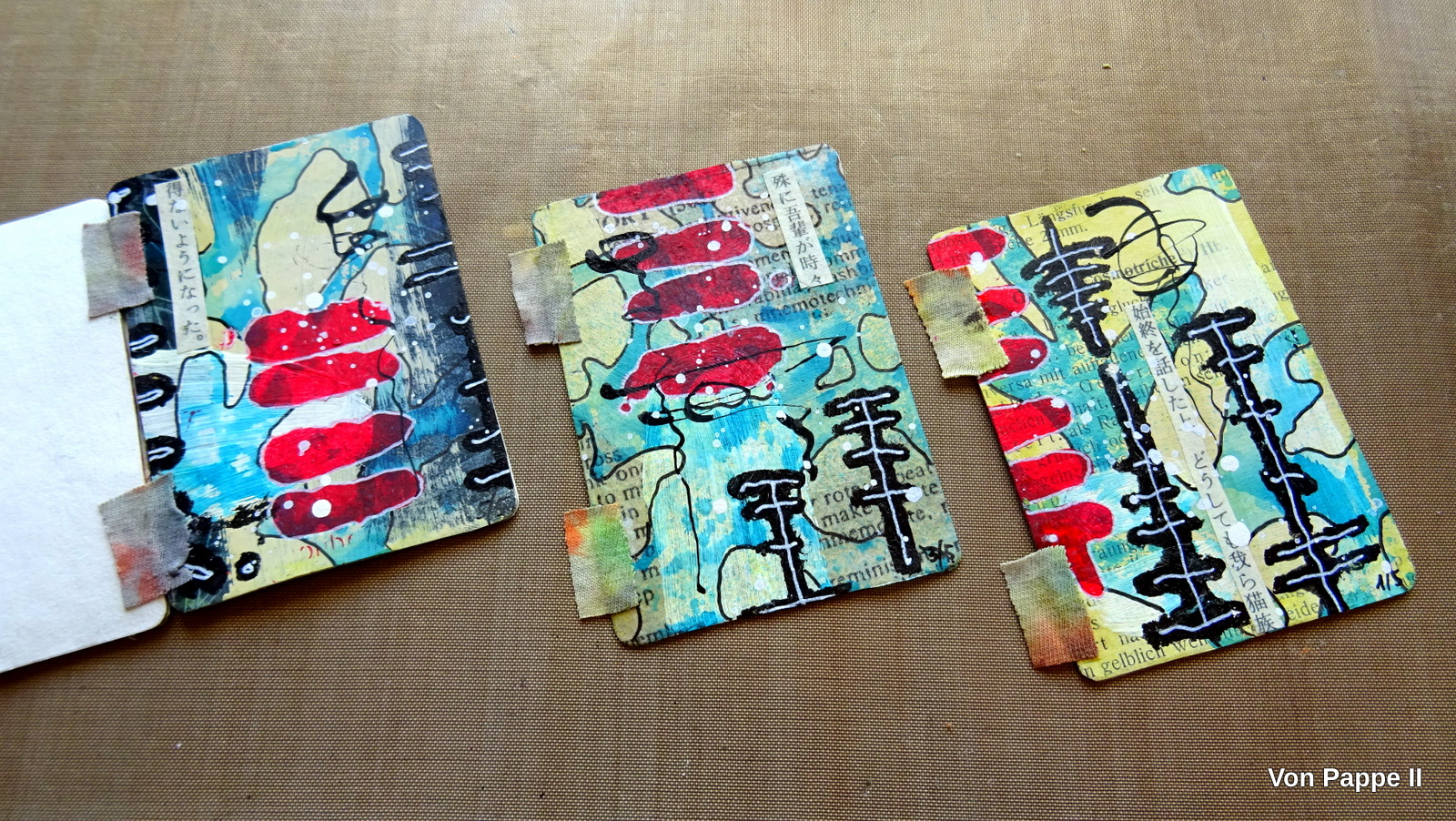
I wanted to create a binding for my ATC booklet that would allow me to add more pages whenever (and how many) I wanted to without having to take the book apart or something like that. So the easiest way was to create fabric hinges and always hinge the following page to the previous one. My search for a thin ribbon wasn't successful, so in the end I cut some pieces of fabric from one of my painting rags. 


The first and second page were easy to assemble....I used more matte Decou-Page as it dries really fast and holds really well. 


While pages one and two were drying, I already glued the hinges to all the following pages and let these dry thoroughly (I also used my heat tool to make sure they were completely dry).


Adding the following pages made me search for something I could stack so the two pages that were going to be fused would lie evenly. I found some MDF blanks to stack and these worked pretty well. 

It was a bit of a fiddly job, first adding the glue to the exact spots on the pages, then to the fabric "tab", then putting it all together in the right spot and adding more glue on top, but I knew I wanted all the pages to really hold together as fast as possible, so I could add a lot of haiku pages in the future. 


I made sure I let the fabric hinges dry in a way so they would not get glued together accidentally (which would make flipping and opening a page impossible without tearing some part of a page off) - so I let my booklet dry like this - with all pages opened: 


Once all had dried, I "faked" some stitching on the fabric hinges by doodling it on with a Faber Castell PITT pen. 


This is how the binding looks once all is done and dry: 


And this is the finished booklet (well, actually it was really finished once I had glued a little strip saying "haiku" to the front page). 


To keep my Haiku ATC Booklet closed I fixed a vintage button to one end of a piece of rough string and wrapped that around the pages. 


You can "read" the book in two ways...holding it in portrait format to look at the ATCs, or in landscape format to read the haiku. 


I love how the first five pages form a visual unit - bound by colour scheme and design - and that the next set of ATC pages will add a different "block" of visually fused pages...and so on. My haiku collection will grow slowly but steadily and I hope for the booklet to become really thick one day...a chunky collection of visual art and poetry...


You could also use this kind of booklet to collect affirmative quotes for example...or to note your favourite peoples' birthday dates in...well, I am sure you will find a lot more creative and useful ways for a booklet like this. But in the first place it is a beautiful way to display and collect your own ATC art - created using large stencils. ;)

Claudia x