Showing posts with label greeting card. Show all posts

Wednesday, November 12, 2025

Using Stencils to Highlight Your Lettering Style & SALE!

Hello Beautiful!

Trena Brannon here, and I'm so happy to spend a little time with you today, sharing a fun and simple project to create a greeting card that will make someone smile.


This technique puts your hand lettering in the spotlight, with the stencils playing a supporting role. We'll also explore how to use different elements to connect the layers of your artwork, making the whole piece feel cohesive and engaging. 

STEPS:

  • Building the base. I started by selecting a stencil (Curve Ball Tile S989) that was airy and open, allowing most of the white card base to show through. This creates a clean, minimal background that provides a nice contrast for the detailed design to come. I gently dabbed on some gouache paint with a sponge, keeping it slightly dry to get those nice, crisp lines.
  

  • TIP: Use a baby wipe to clean your stencil and transfer the paint onto a journal or scrap paper. It's a great way to start your next creative project! I learned this from my stencil sister, Carolyn Dube!
    • Connecting the layers. I used the same stencil on a piece of colored cardstock, using a similar color of paint to create a subtle tone-on-tone effect. This immediately begins to connect your different layers.


    To see it better, here's a shot of the piece of cardstock on a black background:

    • Adding a second connection. Next, I used a different stencil (Diamonds and Kisses Tile) and applied the color I used on my white card base. Repeating a color throughout the piece is another great way to create a feeling of connection.


    • Making the details sing. Now for a bit of contrast! I used a tiny detailed stencil (Couture ATC Patterns) to add little pops of white. Using the same color as the white card base helps tie everything together and adds some interest through a contrast in scale.  For more flexibility in using the ATC sections, I cut them out of the larger stencils.


    • Lettering with joy. Now for the most stylized part that personalizes the card —your lettering! I did a few quick very rough sketches on scrap paper to find the style I wanted. Then, I used a black brush pen to draw the letters on my orange cardstock, leaving enough space inside each letter to see a piece of the design. It's so important to have fun with this part! As you can see, my letters aren’t perfect—and that's okay! They are drawings of letters - that's what makes them unique. Initially, I forgot my "y." 😁


    • Bringing it all together. Once my letters were cut out, I played with their arrangement until I found a placement I loved. Before I glued them down, I added a few small black dots to the base layer—a final chance to connect color in the letters to the base card. I chose a bouncy, playful look that conveyed a sense of joy.


    • TIPS: 

    After cutting your letters out, use a black marker to darken the edges. This gives them a nice, finished look and tidies up any stray cuts. I do this from the back side of the cardstock to avoid accidentally drawing onto the design side. 

    Take a photo of your final layout before you glue anything down. It's the perfect guide to keep you on track.


    • One more detail: To make the card even more special, I added a design element to the envelope to give the receiver a hint of what's inside. 


    Here are the Supplies I used: 

    Stencils: 

    • substrate/surface: white and color cardstock
    • stencils: Curve Ball Tile S989Diamonds and Kisses TileCouture ATC Patterns
    • color: gouache paint dried in a palette, reactivated with distilled water - the white paint was freshly squeezed
    • tools: sponges, black marker pen, color pencil, scissors, craft knife, cutting mat
    • adhesives: low tack tape, permanent tape runner

    All my stencils are on sale for the next two weeks! Use code: TB20.

    When you create a card or another type of art piece with this technique, I would love to see it! Feel free to tag me on Instagram @trenabrannon and/or Facebook at TrenaBrannon Art & Design.

    Take care and stay positive! 

    Trena

    =========================

    Friday, June 14, 2024

    Wildflower Greeting Cards


    Hello stencil friends! Nicole here with a fun tutorial. Today I'm to creating a handful of wildflower cards. I love how quick and simple it is to use a couple of stencils and some paint to make cards that definitely look like you spent a lot of time making them.

    For my cards, I went with a grungier, earth tone palette. However, this design would look gorgeous in any colors. So, choose your favorites, and let’s get started!

    I began by lightly gessoing some ledger paper. If you don’t have ledger paper, old book pages would be just as lovely. You could also find some ledger printables (Be careful about printer ink running; you might need to seal them.) or create your own background interest with stamps.

    To lightly gesso, I simply plopped a few drops of gesso on the page, sprayed with water, and quickly spread it all around with a brush. This does a couple of things. First, it adds a little more integrity to the pages. And second, it seals them just a bit for all the layers I’m about to add. 


    Once that gesso was dry, I added some sepia colored India ink. I concentrated the ink on the edges of the paper where I planned to cut the card fronts. This process is a lot of fun. Simply water down the ink, spread, spray with water, splatter, and add more as needed. (You can watch my process in the video below!)

    It does take a bit for the ink to dry, but don’t rush that process too much with a hairdryer. The ink will pool and puddle to create nice effects on your papers as it dries.


    Some of my papers weren’t dark enough, so once they dried I added a bit more ink in places and more splatters.


    Next, I grabbed the floral waterfall stencil to add a bit more texture to the background. I had two ideas for this, so I tried them both!


    For my first idea, I used an applicator and some titan green pale acrylic paint on a few papers.


    For my second idea, I used some parchment spray paint.


    For both applications, I mainly stenciled on the sepia ink areas. I wanted the stenciling to be on the edges of the card fronts as to not interfere too much with the wildflowers. Both ideas worked great, and honestly, I like them both! Spray painting might win out just because it was a little faster. I did miss some of the green color in the spray-painted ones, so I added some green splatters and even stenciled a couple green florals here and there on those as well.


    After the stenciling and spray-painting were dry, I cut out my card fronts. Since my cards are 4.25 inches wide and 5.50 tall, I cut the card fronts .25 smaller (4 by 5.25). 


    At this point, my pages were feeling a little chalky from the gesso, ink and spray paint. I decided to add a nice layer of matte medium on top to smooth out that feeling and seal the pages even more for my next step.


    Once they dried, it was time to add the wildflowers! I grabbed the wildflowers and grasses stencil and my Payne’s gray paint to begin. For each card front, I positioned the stencil how I felt it looked best with the background layers. 

    I gently used the applicator through the stencil to add the flowers. This is a simple process, but let me to share a couple helpful tips that might make it even easier. 


    Don’t load too much paint on your applicator. Then, as you stencil, hold the stencil tightly to the back paper and use the applicator gently. I often work in small circles, and sometimes I pounce to get more paint in spaces. Most importantly, if the foam part of your applicator gets too messy or wet, get a new one!  I always throw my used ones in my paint water so they don't dry out, and I wash them with my brushes.

    When you think you’re finished, lift the stencil partly and check! You can lay it back down and stencil more as needed.


    Before the wildflowers completely dried, I added some watered-down Payne’s gray paint and messed up some of the stenciling. I like how this adds imperfection. It also helps disguise any problem areas!


    The final step is to stick your card fronts to some colored cardstock, and you’re finished! I like to make several cards at once so I always have cards on hand. It’s easier to make 12 at one time, than one or two here and there.


    To watch my process, check out this video.


    I hope this inspires you to make some cards. I can’t to see what colors you choose.


    Thanks for following along!

    -Nicole


    Connect with me on


    Stencils

    Supplies
    • Vintage paper (ledger, book or a printable)
    • Bombay India Ink (sepia)
    • Golden So Flat Acrylic Paint (Payne's gray, titan green pale)
    • Spray Paint (parchment)
    • Applicator
    • Gesso
    • Cardstock
    • Tape-runner adhesive
    • Matte Medium


    Tuesday, September 27, 2022

    Simple Fall Inspired Cards


    Hello and happy fall! 


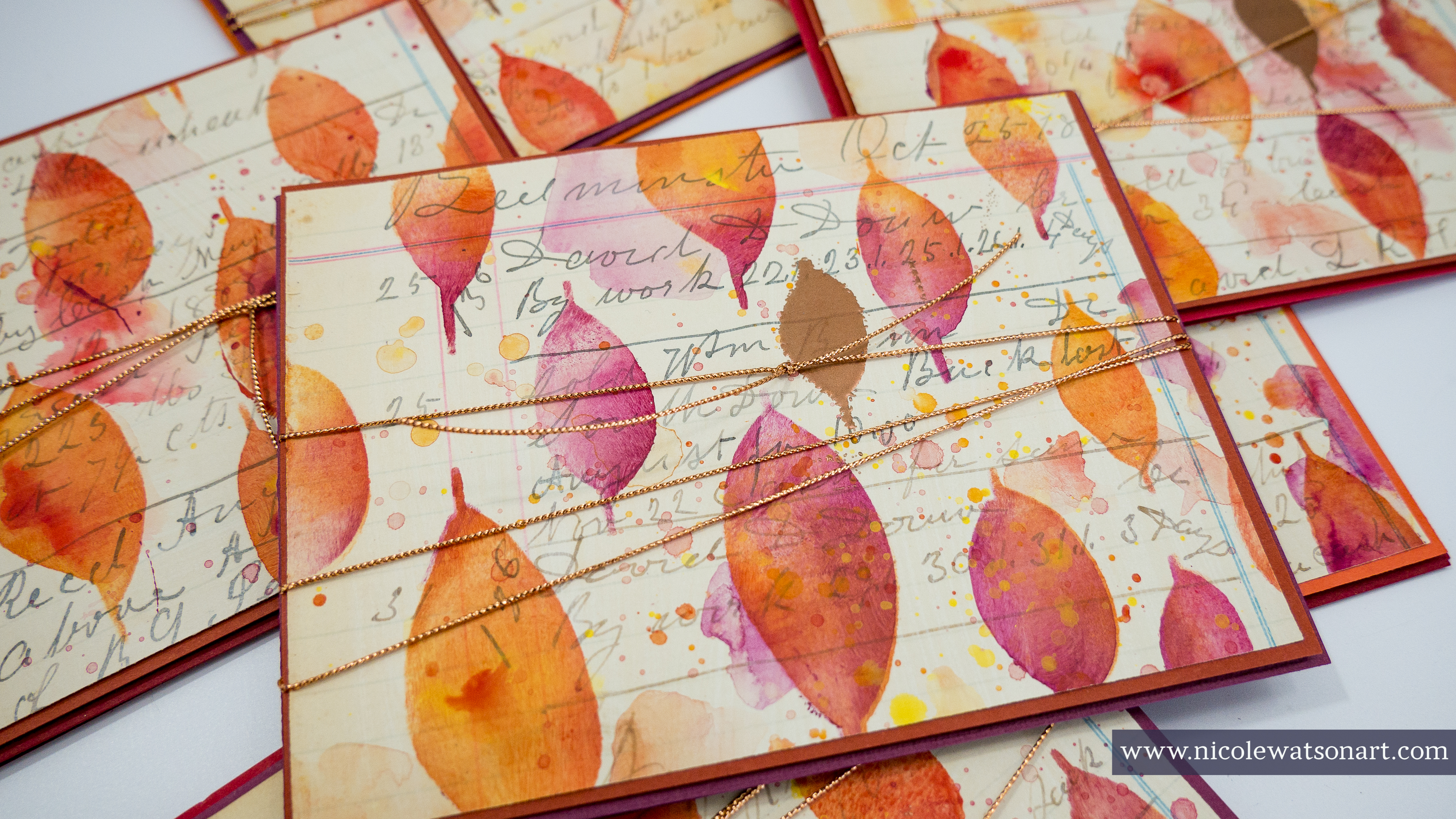
    Nicole here to share a fun, quick and easy card that’s perfect for the fall season. It’s almost starting to feel a little more fall-like here in Central Texas, and I am waiting in anticipation for our leaves to start changing. Until then, I am going to have to be satisfied with making my own fall leaves.


    I always like to have a variety of cards on hand for sending happy mail or tucking into giveaways and attaching to art that someone purchases from me. With my stash dwindling a bit, I needed to get creative to make some more. 


    Often when I sit down to make cards, I find making multiples takes just about as much time as making one. (Plus the supplies are all out!) In just under a couple hours, with four large ledger sheets, one stencil, a bunch of paint, cardstock, and a few other supplies, I was able to create 10 cards and 10 different postcards.


    I began by adding a small amount of watered-down gesso to some vintage ledger sheets. If you don’t have a ledger that’s falling apart or that you want to take pages out of, you could also use book text or even use your own handwriting on some pages. This card would be awesome with a fall poem as the background, too!


    The way white gesso mingles on the old book text is one of my favorite layers, however you can also use clear gesso. The white doesn’t cover up the pages much at all, it just adds a sort of chalky-like coloring. The gesso protects the pages just a bit from the paint we’ll be adding next.


    Once that gesso was dry, I grabbed my closed leaves stencil, all the fall (warm) colors from my Dina Wakley Media paint, sponge applicators and some patty paper for my palettes.  


    Begin with one of the fall colors. I like to start lighter and then progress to darker colors. (By the fourth ledger sheet, I just had fun and didn’t use that rule!) Use the sponge applicator to stencil loosely inside the leaf shapes. Don’t stencil prefect; keep some of the leaves half stenciled. Lift the stencil and repeat the process to fill maybe about half of the page or so. My favorite part about this particular stenciling process is that it does not have to be perfect.

    Then, pick up another color and place the stencil in the same spots to add color to the leaves and complete the shape. Repeat this process with several colors on the page. All these colors mix beautifully together, so you do not have to worry about making mud. A quick note, if this isn’t making sense, I have a video of the process linked below!


    Once the page is full of leaves, grab a paintbrush and add splatters, watered-down pools of color, and even paint a bit on top of the leaves. Use this process to add interest, grunge the page up a bit, and disguise any problem areas.


    Repeat this process with several different color combinations on all of the ledger sheets.


    When the sheets are dry, cut the pages into card fronts (mine are 4 by 5 ¼"), and also cut colored card stock into base cards and a layering card as well (the layer is 4 1/8 by 4 3/8").


    At this point, you can assemble the cards as they are, or add some embellishments like I did. 


    I decided it would be fun to add one embossed leaf to the front, so I squished versamark ink through one of the leaves on the ledger page. I chose a spot that needed a leaf and whatever size leaf fit best. Be careful to not get the versamark anywhere else, by using a mask to prevent this. 


    Then, I sprinkled copper embossing powder on top and use a heat gun to melt it.


    After repeating this process nine more times, I added the ledger sheets to the layering card. I felt they needed something else, so I wrapped them with some copper string. 


    I stuck the card front to the base with some dimensional foam adhesive.


    When the cards were finished, I still had some leftover stenciled papers that were odd sizes, so I made some postcards with those.


    This process was so much fun to make cards with. I anticipate myself making similar cards each season with a different stencil. Winter snowflakes, spring flowers, summer sunshine… or even shapes in seasonal colors. I’m getting excited just thinking about it!


    Check out the process video below (or click here!):


    I hope this inspires you to create some cards and send some happy mail! If you do, be sure to tag me on social media so I can see your beautiful art


    Happy Fall!
    -Nicole


    Connect with me on


    Stencil

    Other Supplies
    • Ledger Paper
    • Colored Cardstock
    • Acrylic Paint (warm/fall colors)
    • Gesso (white)
    • Palette Paper
    • Paper Trimmer
    • Versamark Ink Pad
    • Embossing Powder (copper)
    • String (copper)
    • Tape Gun
    • Adhesive Foam
    • Heat Gun
    • Sponge/Foam Applicators

    Tuesday, March 29, 2022

    One Stencil Three Ways in a Pop-up Greeting


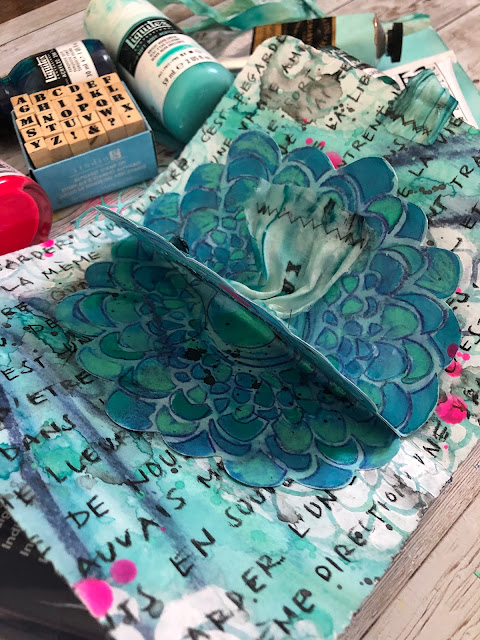
    My friend Melenia from Greece, who lives on the island of Crete, has a birthday in April.  I know from experience that the mail takes a very long time to deliver any of my packages to her, so I planned in advance in making her a special birthday card.  I used one stencil three different ways to create a pop-up card that I know she will love. I used her favorite color and incorporated French proverbs and sayings about friendship, because we are both trying to practice our French.  

    I used one of my all-time favorite stencils: Traci Bautista's Double Zinnia Mask and Stencil

    Here's a list of other supplies:
    -Medium weight mixed media paper (2, 9x12 inch sheets)
    -Water soluble crayons and mark makers
    -Iridescent acrylic ink
    -Spray bottle with water
    -Brush
    -Sponge
    -Acrylic paints, 2-3 colors, plus white
    -Scissors
    -Glue Stick
    -Watercolor pencil
    -Tissue paper
    -Matte medium
    -Lyra Graphite Stick
    -Stabilo Marks All, black
    -Rough edge ruler
    -Letter stamps and ink pad

    Here's the step by step:


    Thank you for reading! I hope this inspires you to make a pop-up card and to use your stencils in different ways!
    XO
    Sarah

    Hi I'm Sarah and Juicy*S is my DJ name. I'm not a DJ. I would love to be a DJ. It's one of my fantasy dream jobs, really. I got this name when my sister, my friend, and I were slinging paint and working in our art journals, drinking wine, and keeping track of the funny things we were saying on a "sign-in" sheet...just craziness. We all ended up with a DJ name that day. I started my first art blog with this name, and I've had it ever since.

    I have found that being creative, that making stuff, is a very fulfilling and beneficial activity for me. Creative play, and art journaling in particular, has become my self-care practice. It's so exciting for me to share what I'm excited about, and helping others find their own creative practice is one of my goals in life!

    You can find me on Instagram @juicy.s.art and my website is: Juicy*S Art
    I also have a YouTube Channel and an Etsy Shop.